Archive for June, 2009
Ask Almost-Doctor Dan: True, False or Meh…
Meet my über intelligent little brother* Dan.

Growing up I was always referred to as “the creative one” which was the family’s way of saying “not the prodigy” which was my brother’s territory. It wasn’t that I was dumb, I routinely made the honor roll and even got accepted early admission into a prestigious university art program in NYC (graduating with only 13 others in my major). But Dan was a bit hard to compete with in the brains department. In high school he took nine AP tests and got fives on all of them (I took one and got a 4). Then he got into Cornell and graduated with the highest GPA of his entire graduating class (a 4.21 if you’re wondering). Yup, out of all of the kids in Cornell’s College of Agriculture and Life Sciences, he was the Valedictorian. Yeah, he’s brainy.
Now he’s a graduate student at Columbia with a Master’s degree under his belt, steadily working his way up to his Doctorate in chemistry with a full scholarship from the National Science Foundation. Not only do they pay for his education but they actually pay him a stipend for rent and food- all in return for wearing a lab coat almost 24/7 and messing around with molecules and polymers all day. Sweet deal huh? Serious Einstein stuff going on.
Anyway, so when he recently visited us we got to chatting about… household chemicals (naturally). John and I love to live as purely as possible and stay away from the nasty stuff, so it was really eye opening to “mythbust” with my mad scientist sibling. What’s dangerous? What’s harmless? Here’s his almost-doctor take on the household habits and materials that’ll do you good or do you wrong.
What’s your take on BPA in plastic water bottles and other household plastics? Most evidence points to the fact that these chemicals are to be avoided, if not only for their effect on humans but also for their effect on the environment. It’s easy to use stainless steel or glass drinking containers to avoid BPA and I can’t imagine a time in the next hundred years that any evidence would point to dangers in glass or stainless steel, so those are a much safer bet.
The YHL takeaway: We love using stainless steel bottles like Klean Kanteen (we keep one at home, one at work, and one in the car for sipping without fear).


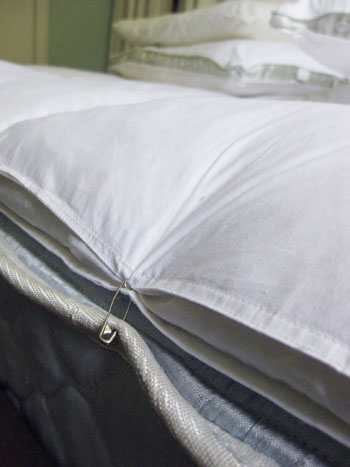
How about fireproofing chemicals that are used in many standard mattresses and pillows? They’re bad news. These objects that touch our bodies on a regular basis contain chemicals that, as they degrade, become “house dust” which you inhale. These chemicals are later found in your body, and even found in mothers’ breast milk, which is scary when you think about it.
The YHL takeaway: Snagging organic wool or cotton pillows without fireproofing chemicals (now available at Bed Bath & Beyond) is an easy upgrade, and the next time you’re in the market for a new mattress, grabbing something organic and chemical free will help you sleep easy (like our new latex one).
What about soaps and shampoos with sodium lauryl sulfate? Is that a chemical to be avoided as well? It’s hard to find things without that ingredient! I’m 99% sure that it’s a completely harmless ingredient. Sodium lauryl sulfate is essentially the product of your body’s metabolism of vegetable oils or fats, so it’s found in your own body when you digest fats- and because you can ingest quite high levels of it (and actually metabolize it) it stands to reason that there’s no danger to put it on your head or you skin.
The YHL takeaway: It’s nice to hear that not everything is undisputably bad for us, although we love Avalon Organics shampoo & conditioner (which are actually sodium lauryl sulfate free… just in case).
Teflon. Yea or Nay? This is a substance I would avoid if possible just to be safe. If you’re careful enough with your cookware (and never heat it to an extremely high temperature) it’s probably just fine. But the best way to be sure is to simply avoid it. Since the thermal degradation of Teflon and similar polymers would release toxic compounds into the air and your food, people have begun to move away from it, but this only occurs at temperatures that are higher than those required for cooking. If you feel that you really have to use it, avoid preheating your pans for unnecessarily long lengths of time, or using your Teflon pans for high-heat cooking. On a similar note, I would also avoid heating any plastics in the microwave (tupperware, saran wrap, etc) since the thermal degradation of these polymers can also occur, potentially releasing toxins into food. Again, as with teflon, normal cooking temperatures are probably okay, so if you feel you really have to microwave plastics try not to overheat them.
The YHL takeaway: We love our new Teflon-free Greenware pots and pans, made from eco-friendly materials that are chemical free (yet gloriously non-stick thanks to the Ceramica technology). And we swapped all of our tupperware out for glass containers (sold at Crate & Barrel and even Target) for safer microwave usage.

What about barbequeing meat? I’ve heard that it releases dangerous carcinogens into the grub. True? Yes, this method of cooking is probably not the safest. Essentially any act of cooking that chars the meat to the point of blackness is making polyaromatic hydrocarbons (aka PAHs) which are poorly metabolized by the body and may result in DNA damaging chemicals that could be carcinogenic. I haven’t heard concrete evidence linking cancer to burned meat so I can’t be sure, but from a chemistry standpoint those chemicals should be carcinogenic. Science points to avoiding them. One way to potentially avoid releasing these chemicals would be to marinate the meat beforehand, and keep it moist while cooking, since heating dry meat results in more charring.
The YHL takeaway: When you fire up the bbq, don’t forget to marinate your meat. And perhaps consider making it a once a week treat as opposed to an everyday effort.

What about phthalates? We’ve heard that they’re in a slew of products and they might not be best for humans or Mother Earth. Dish! I’ve only heard of these being used as plasticizers in bottles and containers, but in general, like BPAs, they appear very harmful to the environment and possibly harmful to humans as well (I’ve heard of studies in which these chemicals have been known to sterilize and even change the genders of fish and frogs).
The YHL takeaway: Say no thank you to phthalates by selecting a slew of products with a label that boasts that they’re phthalate free (we love companies like Tom’s Of Maine and Dr. Bronners for their dedication to avoiding ‘em).
What’s something major that we should all stay away from? Anything that sets off multiple alarms in your mind when you picture people using these materials or products on a daily basis? In general from my random label-reading I would say that the most toxic ingredients you can find are usually in glues. For example the solvent for the glue used in model building is toluene, which is a potential carcinogen. Glues like Superglue also contain volatile organic compounds that are quite toxic until the glue dries, so if you are going to use these products using them in a well ventilated area is very important.
The YHL takeaway: Good to know. From this point on any glue-related craft project will be relegated to the great outdoors where it will remain until thoroughly dry.
Anything else we can glean from Almost-Dr. Dan? I think the vast majority of organic compounds that are dangerous have strong smells, so in general if you smell something that has a chemical odor it’s best to use it sparingly or with adequate ventilation.
The YHL takeaway: Make like Tucan Sam and follow your nose- and switch to something less stinky when you can. And if you’re seriously wondering what cyanocobalamin is, just ask your geeky brother (or mine). It’s a B vitamin by the way.
So there you have it. A slew of straight household-chemical-related answers from my brother, who spends 99% of his waking hours holding a test tube. For more ways to keep your home healthy, check out how we swapped out a few things in our home to live cleaner and greener in a snap. And feel free to pipe up with other ways to clean, bathe, and cook in safe and oh so smart ways!
*Yes, Daniel is my bona fide brother. Same mom and dad. He got the dark, brooding Italian hair and eyes from my mom (with a name like Diana Teresa DeCesare LaPadula she’s totally Italiano) and I got the fair skin and light eyes from my Austrian dad’s side of the family.
The After Party: Year Two
We know there are plenty of you out there with amazing before & after photos (after all, you guys blow us away with your Reader Redesigns on a regular basis) so that’s why we’re all about spreading the word about One Project Closer’s 2nd Annual Before and After Event, benefiting Habitat for Humanity.
One Project Closer (if you don’t already know and love them) is a great home improvement site run by two couples in Baltimore, MD. They offer tips, how-tos, product reviews and giveaways with more of a heavy duty, power tool spin. And they’re following-up their successful 2008 Before and After Event with another summer-long feature of readers’ pictures… but this year there are more prizes to be won! Here’s the gist:
- You submit your story and pictures of a project you did yourself around your home
- Each week, OPC features one submission on their site and donates $35 to Habitat for Humanity in that project’s honor
- And (new this year) if your submission is featured, you also get to pick a prize – like a $25 gift card to Lowe’s, Home Deport or Amazon)
- At the end of the summer, we’ll all vote on our favorite project and that winner gets an additional $150 home improvement gift card.
You can read more (and learn how to enter) right here on OPC’s official page. The event runs through September 20th but don’t wait too long- your chances of being featured are probably better if you get your project in asap!
And I’m sure they’d appreciate if you helped spread the word too – either in a post or by putting up one of their sidebar buttons (provided at the bottom of their site).
We can’t wait to check out the makeovers that you guys submit. Sherry and I actually just sent off one of our recent projects (not the porch, mind you!) so we’re crossing our fingers that it makes the cut…
Screengrabs courtesy of One Project Closer.
Freestyle
When we upgraded to our new organic mattress this week, it left us with a spare queen mattress that we had no use for. We considered a few options for getting rid of it – selling it on craigslist, donating it to Goodwill, etc. But in the end we decided it was the perfect opportunity to give Freecycle a try.
Freecycle is a system you guys actually taught us about. It’s a network of locally run message boards where people can exchange unwanted items for free. It’s a pretty simple concept, but it seems to work very well at keeping unwanted items out of landfills. Heck, the Richmond chapter alone has over 150,000 listings posted (you can find the closest chapter to your hometown right here). We joined the Richmond list months ago to learn the ropes, but hadn’t actively participated until this past weekend (thanks to our mattress situation). Here’s how our first adventure in Freecycling went down:
On Sunday afternoon I posted this simple message on the Richmond Freecycle board based on the guidelines of the group: “OFFER: Queen Mattress, Bon Air. Queen mattress (Sealy brand) in fair condition, just upgraded to organic mattress and don’t need it anymore…” It’s a super easy formula to follow. Just lead with the word “OFFER” if you have something to give or “WANTED” if you’re seeking something to receive. After that it’s just a quick description of the item and your location.

Lucky us, our offer of a free queen-sized mattress tickled someone’s fancy almost immediately. It took just one hour for someone to respond to my listing (via Yahoo! Chat, oh technology).

Now, it’s worth mentioning that it’s smart to exercise a bit of caution when arranging meet-ups with strangers (need we mention the recent horror stories about craiglist?). Some people may prefer to meet in a public place, but with a mattress and a small car it didn’t really make sense for us (but we were certain to coordinate the exchange for a time when Sherry and I were both home during daylight hours. And we of course kept our loud-mouthed guard dog nearby). So we gave our free-mattress-hunter some quick directions to our house and got his free gift ready for pick up on the porch.

The guy arrived about 20 minutes later with his wife, son and truck. We learned that they had been put in a tight spot because their landlord had defaulted on his payments, giving them almost zero notice that there were being kicked out. They barely had enough time to pack more than a few bags before they were essentially homeless (and completely bedless). This free mattress meant they no longer had to sleep on the hard floor of their new place. You can imagine how happy we were to watch it ride away with a family in need, absolutely no money exchanged. We smiled for the rest of the day.

Then all that was left to do was to post our follow-up “TAKEN” message (meaning the previously offered item is no longer available). It felt almost unreal that we were doing it a mere 90 minutes after posting our “OFFER.” So what’s our take on Freecycle after our first swap session? Quick, simple, and win-win. It’s all about people coming together to help each other out (strangers no less) while keeping things out of landfills. What’s not to like about that?
Have any of you had good experiences with Freecyle in your area - either giving or receiving something for zero, zilch, nada? We can’t wait to keep an eye out for a free item that we might need (perhaps one that needs a makeover…) – after all, we figure we’ve earned a few good karma points towards something, right?