Our neighbor recently asked for help adding a drip irrigation system to their new garden. My last experience with a DIY irrigation installation was pretty intense, so I was wary. But installing drip irrigation was the total opposite. It was easy, affordable, and fast. Plus, it only cost around $75 and took just a few hours to install. It’s also a much more efficient way to water your plants than traditional sprinklers – so there’s a lot less water waste.
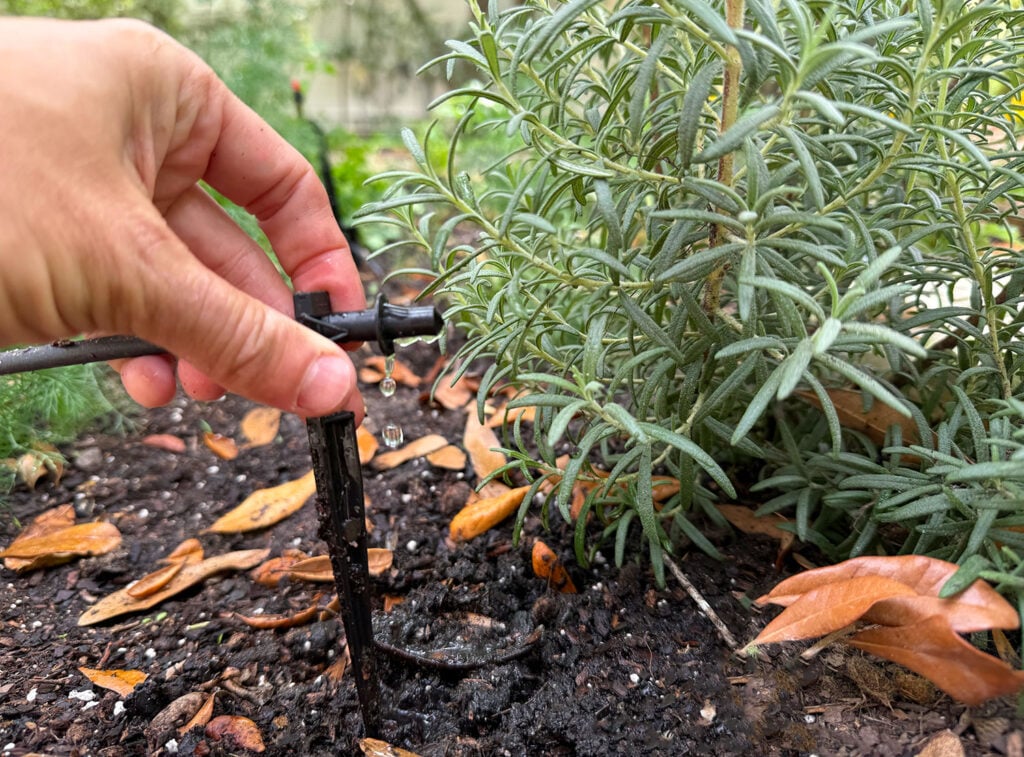
Drip irrigation systems can be installed right onto a typical outdoor spigot, so no special equipment or plumbing experience is needed. They’re great for flower beds, vegetable gardens, shrubs, and even large trees because you get precise control of the amount of water that each plant receives.
What is Drip Irrigation?
Drip irrigation is an easy & efficient method for watering plants in gardens, mulch beds, containers, and more. Unlike sprinkler irrigation, which is used for lawns, drip systems deliver water directly to the soil at the base of each plant through slow, low-pressure hoses. This has several advantages:
- Less wasteful: Less water is lost to evaporation, overspray, and runoff than with sprinkler systems. Drip irrigation systems are said to use up to 50% less water!
- More efficient: Precise watering to the plant’s root zone means shorter, more effective watering times.
- Highly customizable: Flexible hoses and a variety of emitters make it easy to get each plant exactly the water it needs.
- Easy to install: Requires no special tools, plumbing knowledge, or previous experience. You can add an entire system in just a couple of hours!
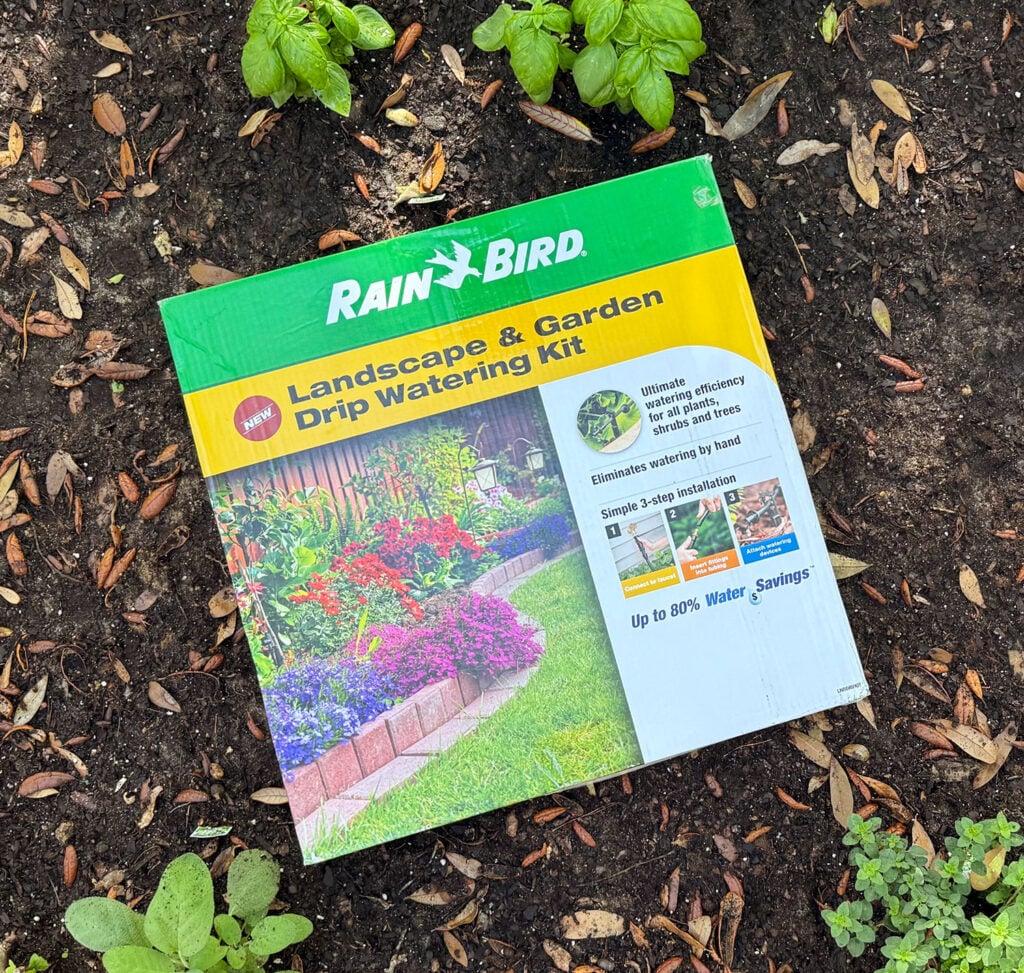
- Affordable: This $55 drip irrigation kit has everything you need (just add a hose timer!).
They are also a more durable, permanent, and targeted solution than soaker hoses. Those are good for quick, low-effort set-ups if you’re getting new plantings established, but soaker hoses tend to deteriorate over time. So once again, a drip irrigation system wins!
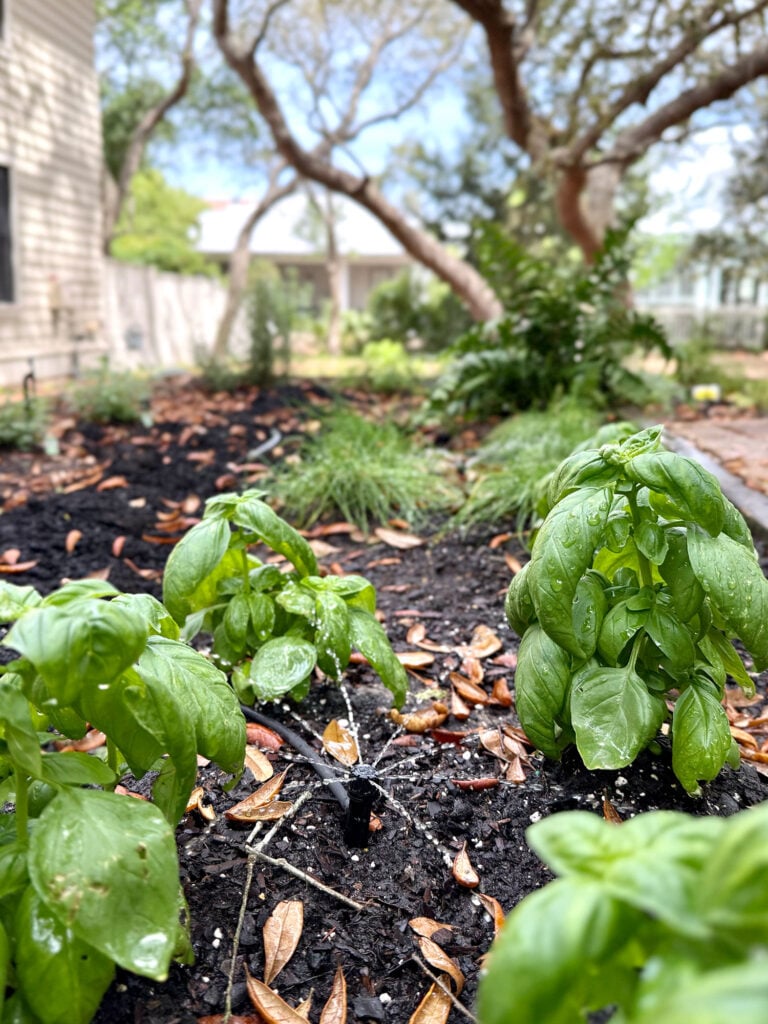
So let this be your sign to drop whatever excuses you’ve been using to put off installing a drip system in your garden or yard. I know I’m kicking myself for not doing it sooner. Yes, I’m adding one to our house thanks to the simplicity and efficiency of the setup that I did for our neighbors.
How Does A Drip Irrigation System Work?
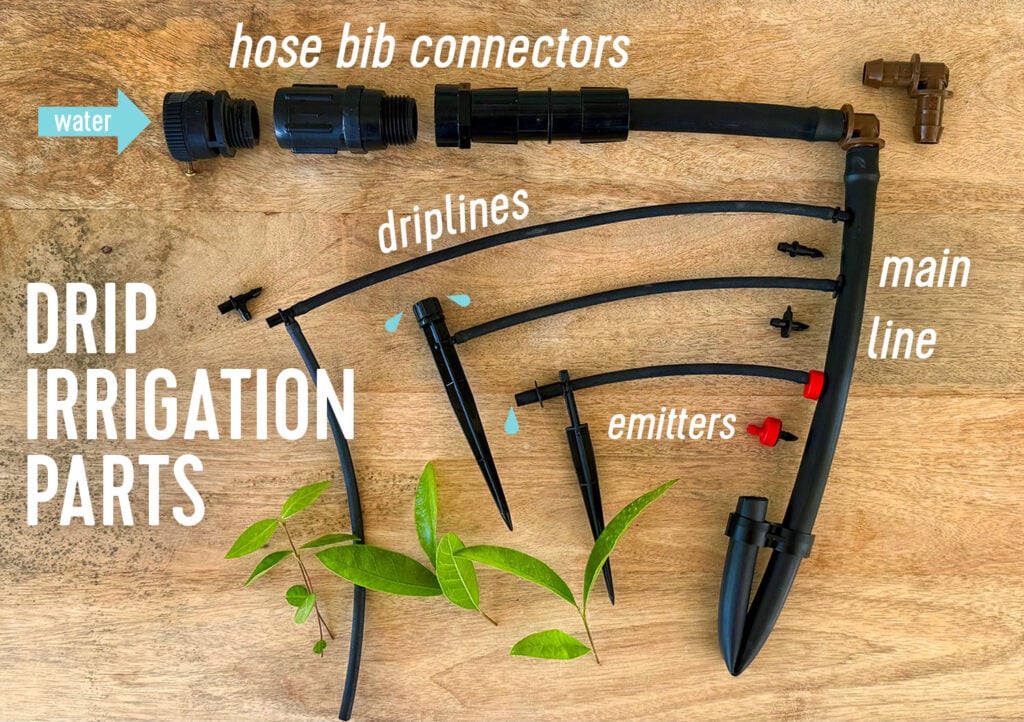
Drip irrigation systems use a series of hoses, flexible tubing, connectors, and emitters to transport a slow flow of water to your outdoor plants. Whereas traditional lawn irrigation uses high-pressure water to activate sprinklers that can spray long distances, drip systems mostly just, well, drip. Here are the key components, all of which are included in this drip irrigation kit (except for a hose timer).
This post is not sponsored in any way. We were just very impressed with the ease of the drip irrigation kit… and it only cost $55! And when you add in a hose timer, which is the only other component you need if you want this to run on autopilot instead of manually, it still clocks in around $75, all in!
Drip Irrigation Tutorial Video
In the video below, we take you through all of the parts of the drip system. You can also read the instructions below the video.
Note: You can also watch this video on YouTube.
Hose Bib Connectors
As I explained in the video above, you can hook up a drip irrigation system to any outdoor spigot or hose bib, but there are a few important items to make this connection. Everything in the list below is included in the the drip irrigation kit except for the hose timer, so buying materials for this entire project is really easy.
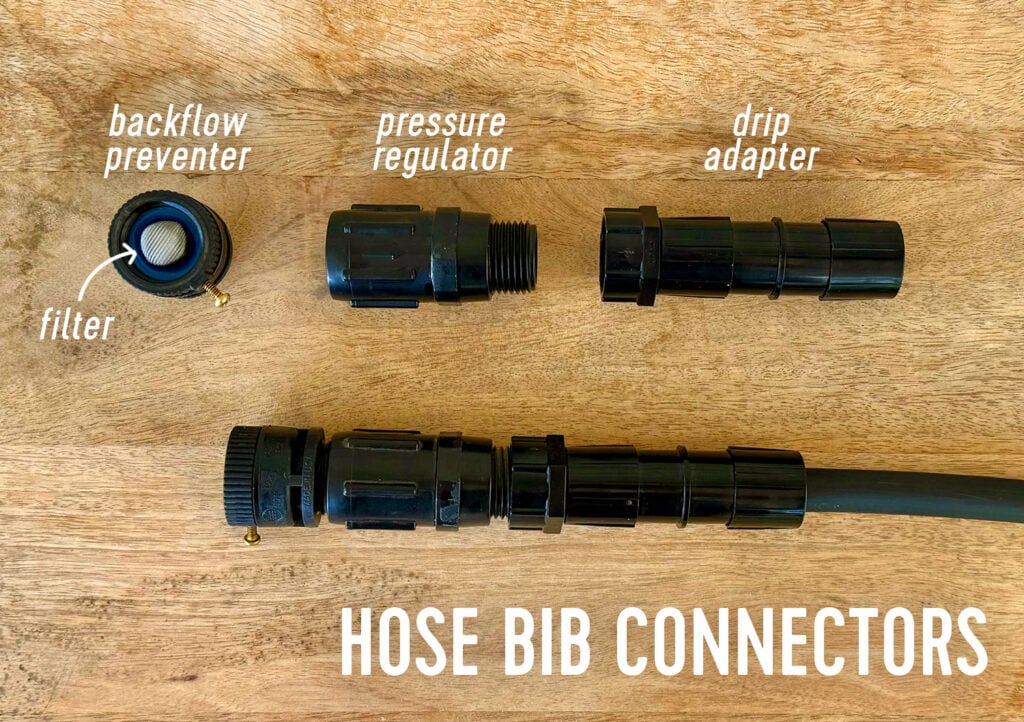
- Timer (not pictured): A sprinkler timer helps you schedule regular, automated watering. You can also buy a multi-zone timer to create separate schedules for different areas of your yard or a smart timer to program from your phone.
- Backflow Preventer: This keeps water in your irrigation lines from flowing back into the municipal water supply, should there ever be a drop in pressure on their end. That way, potential contaminants in your yard (fertilizers, pesticides, etc) don’t get in the local drinking water.
- Filter: A small mesh filter (usually included in the backflow preventer) keeps debris like sand and rust from clogging your lines
- Pressure Regulator: This helps reduce and stabilize the water pressure from your hose to a lower, consistent flow that’s more suitable for drip irrigation.
- Drip Adapter: Lastly, this connector allows you to attach 1/2″ or 5/8″ irrigation hose to a standard 3/4″ hose bib.
Once again, all of these pieces (except for the timer) are included in the kit. I loved how simple it was to just grab two things and be able to do this whole project myself in a few hours. If you’re setting up multiple zones, you can buy additional connection kits that include all of the pieces linked above.
Main Line
The majority of a drip irrigation system is a series of flexible hoses that can be arranged to fit your space. The “main line” transports water from your spigot throughout your garden (not to individual plants), sort of like how a water main runs through your city or neighborhood (not to individual houses).
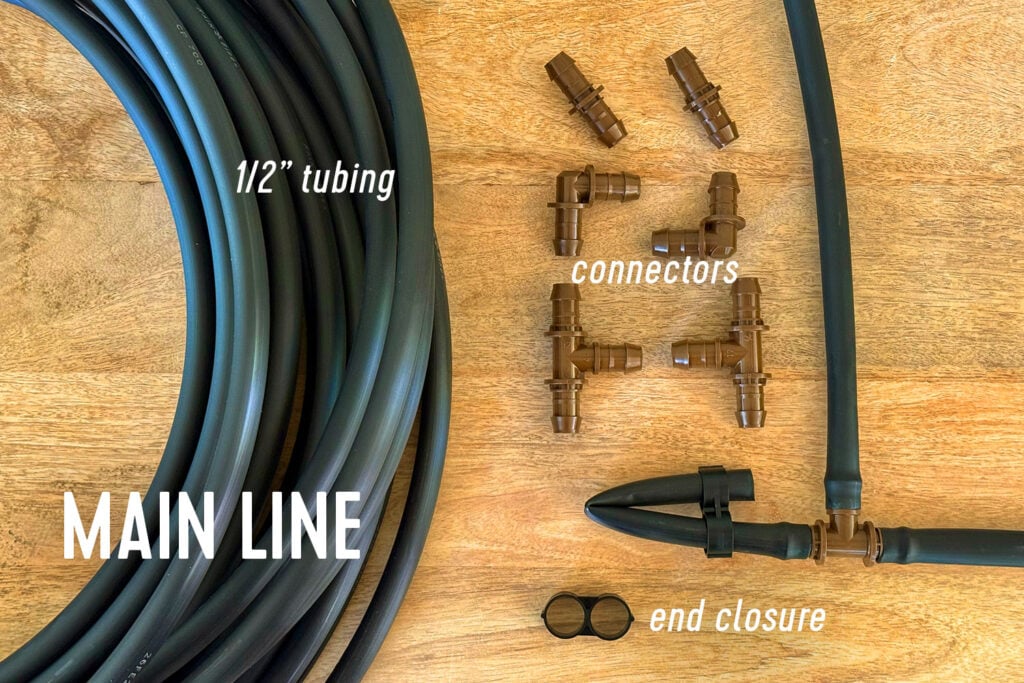
- 1/2″ Tubing: This 1/2″ polyethylene tubing – sometimes called flex pipe or “funny pipe” – is sold in various lengths. It can be cut using household scissors.
- 1/2″ Connectors: These connect sections of main line tubing and come in a variety of shapes (tees, elbows, etc) so you can match the shape of your space. Simply push the tubing onto the barbed ends to secure it.
- 1/2″ End Closure: These end closure rings pinch the open end of your main line closed.
Driplines
From the main line, a variety of smaller, flexible driplines branch off to the individual plants. Think of these like the unique water lines that connect individual homes to the municipal water main.
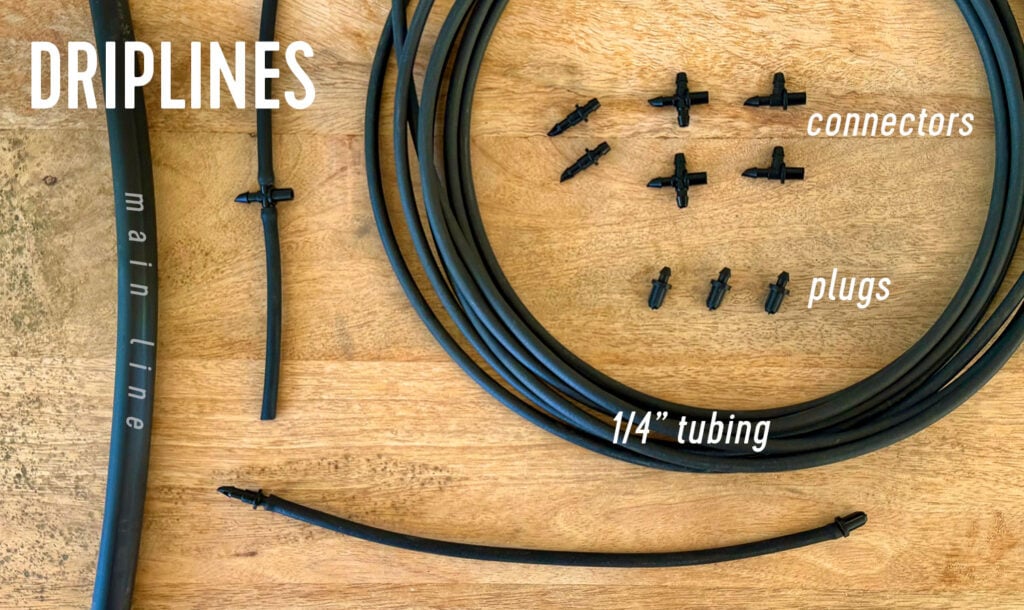
- 1/4″ Tubing: Also called distribution tubing or “spaghetti pipe,” this is a smaller, flexible hose that can also be cut using scissors.
- 1/4″ Connectors: These barbed connectors are similar to those for the 1/2″ tubing, but are also used to connect each dripline into the main line. You do this by puncturing one barbed end through the side of the main line.
- Goof Plugs: These are barbed endcaps that can be used to plug any open ends of 1/4″ tubing. They can also be used for any small puncture in your 1/2″ main line.
Emitters
Emitters are the small devices on your driplines that determine how (and how much) water is delivered to each plant.
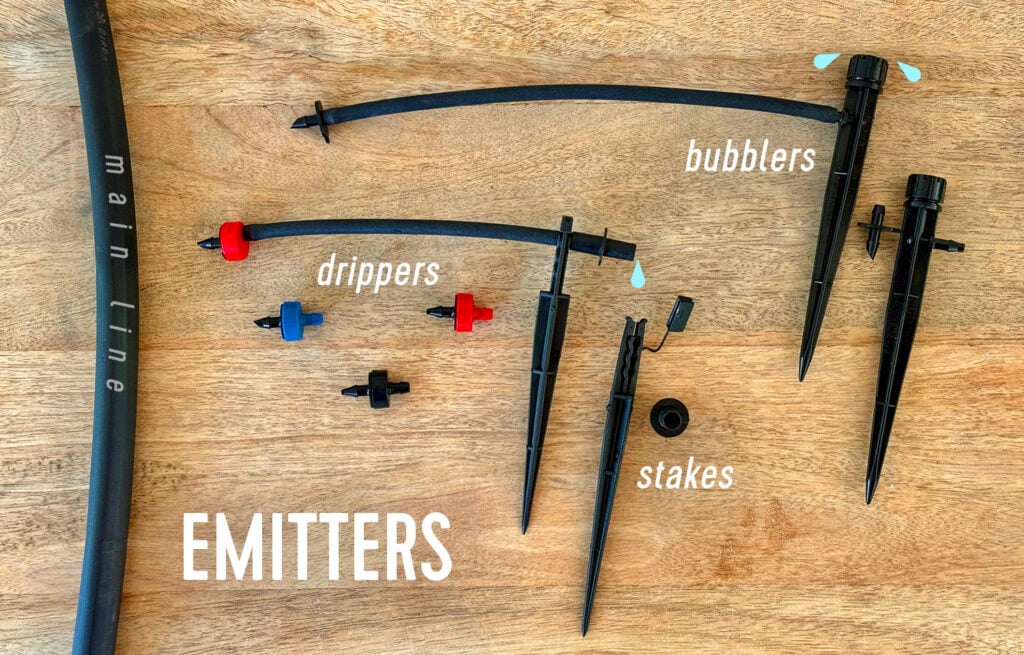
Here are some common types of emitters:
- Drippers: These are the most common emitters in a drip system. They are installed at the start or in the middle of the dripline and control the release of water to a consistent drip. Different colors indicate different flow rates measured in gallons per hour (GPH). Commons speeds are 0.5 GPH, 1 GPH, 2 GPH, and 4 GPH.
- Tubing Stakes: These clips hold the ends of your driplines so you can stake them exactly where you want them.
- Bubblers: These attach to the end of a dripline and emit 8 small streams of water in a tight circle, reaching a small cluster of plants.
- Sprayers (not pictured): These emitters are closest to a traditional sprinkler, with a spray head placed on a raised stake. Sold in full circle, half circle, and quarter circle varieties.
And that, folks, are all of the key pieces that go into a DIY drip irrigation system.
Steps To Install A Drip Irrigation System
Now that you understand the parts of your drip system, putting it all together is very straightforward.
- Plan Your Layout
- Gather Supplies
- Give Your Tubes Some Sun
- Attach Timer & Hose Connectors
- Run The Main Line
- Connect Driplines & Emitters
- Test & Program Timer
Step 1: Plan Your Layout
An important first step is planning how to lay out your drip irrigation system. They’re pretty easy to adjust as you go, but having a general plan ensures you’ll have enough supplies. Important pieces of information are:
- Where is my water source?
- How many zones do I need on my timer?
- Are there any obstacles (decks, sidewalks, fences) I need to plan for?
- How many plants am I trying to reach?
- Do some plants need more water than others?
- What types of emitters do I want?
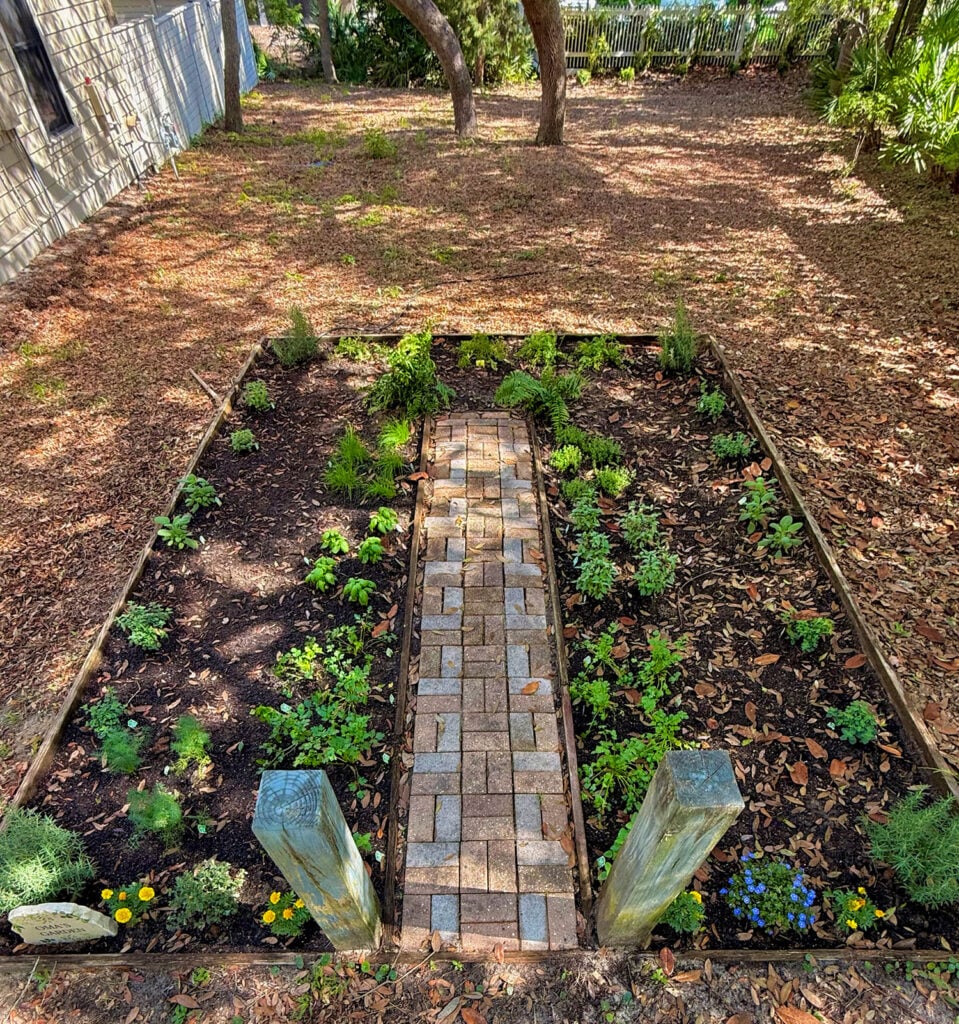
For reference, here is the space we wanted to water. This is my friend’s yard. He asked for my help installing irrigation to their new herb garden.
And here is a rough map (with key!) of how we laid out his drip system using the materials in the kit (we did buy some extra bubblers too – they’re about $1.50 each). We relied mostly on sprayers and bubblers, and then filled in with drippers for any plants that we felt weren’t getting enough spray.
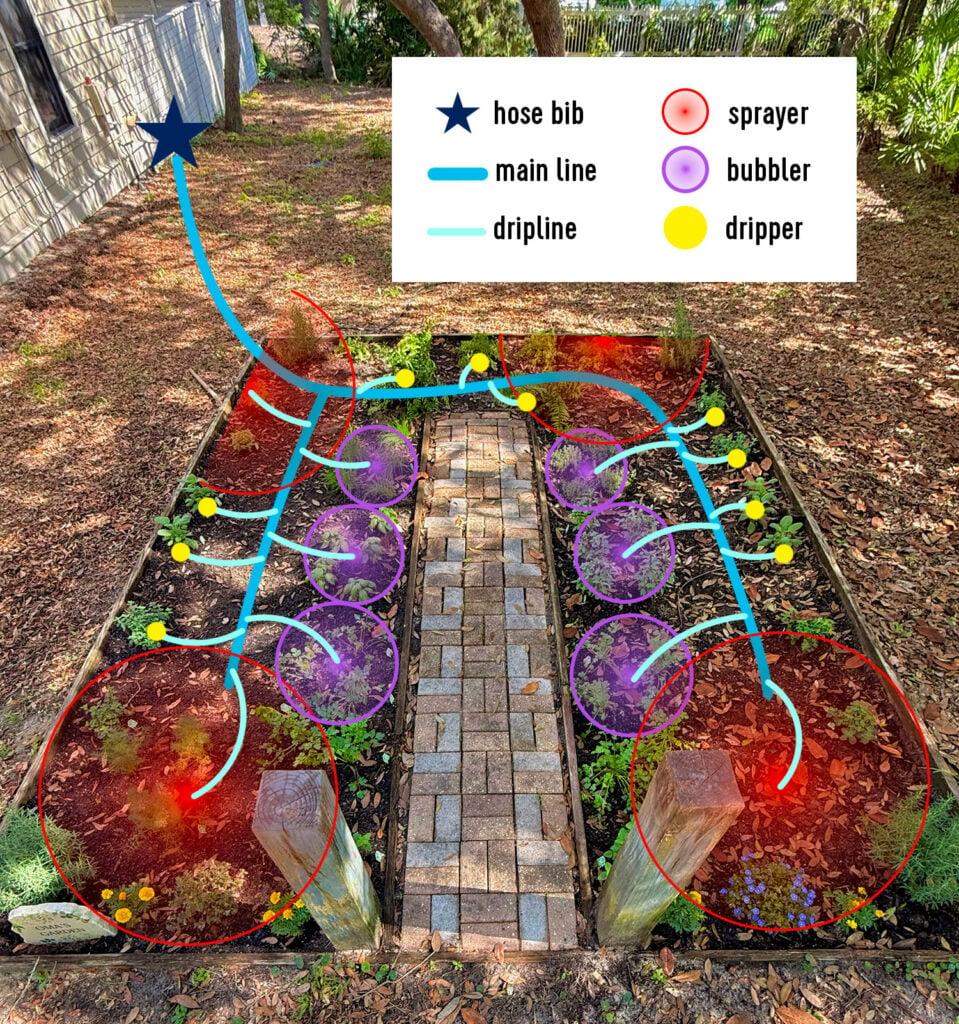
The kit also includes guides with recommendations for layouts as well as watering times & frequencies.
Step 2: Gather Supplies
Again, purchasing this drip irrigation kit and a hose timer may be all you need to install your system. But here are some situations that may require additional materials:
- If you’re creating multiple zones, you’ll need additional hose connectors (backflow preventers, pressure regulators, etc) for each zone.
- If your water source is far from your plants, you may need additional coils of 1/2″ tubing and connectors. The kit includes 50 feet.
- If you have lots of plants, you may need additional 1/4″ tubing, emitters, or stakes.
- Also, you may want/need additional emitters ( the kit includes 20 drippers/stakes, 2 bubblers, and 4 sprayers).
The good news is that most emitters and connectors are very affordable (usually only a few bucks). The most expensive supply will probably be your timer. Our neighbor opted for a a 4-zone timer, which cost $60. More than the irrigation kit itself! But a simple hose timer like this would do the trick well if you’re just adding one zone that you want to water (for example, a side garden or a front landscaping border).
Step 3: Give Your Tubes Some Sun
This sounds silly, but before you begin assembling anything, lay your tubing out in the sun for about an hour. The heat makes the tubes a little more malleable, which will make all of those pressure connections easier on your hands.
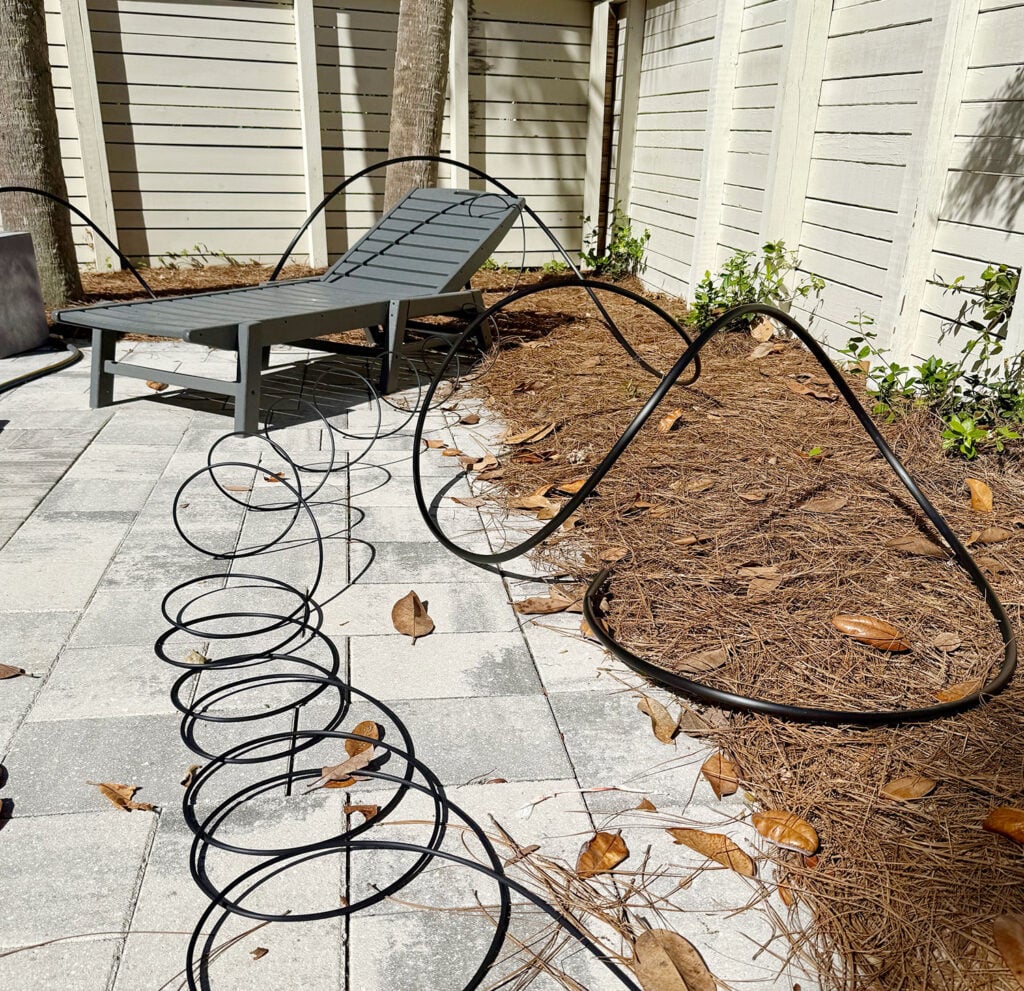
This is also a good time to start laying out your emitters, digging any holes or trenches you want to create, or getting started on the next step…
Step 4: Attach Timer & Hose Connectors
As I described in the video, you want to start by connecting the pieces to your spigot or hose bib. This includes your timer, backflow preventer (with filter), pressure regulator, and drip adapter. Screw everything together and hand-tighten it. You can check for leaks once your system is fully attached.
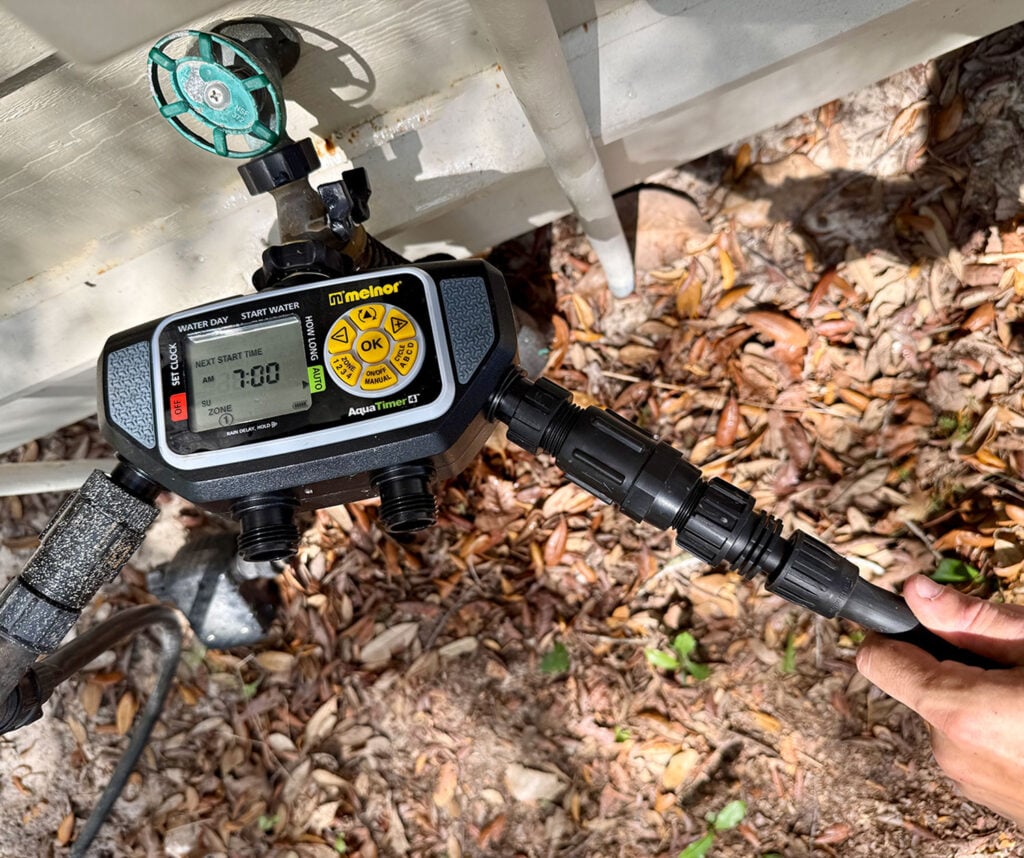
When you’re ready, you can also attach one end of your 1/2″ main line tube to the drip adapter. Depending on your adapter, it should attach with pressure and a small twist.
Step 5: Run The Main Line
Next, run your 1/2″ tubing from your water source to and throughout the main areas that you will be watering. It doesn’t need to run right up against your plants, just within a few feet of them, ideally. Use barbed connectors to split or turn your line as needed. Just push the tube onto the barbed end to connect it.
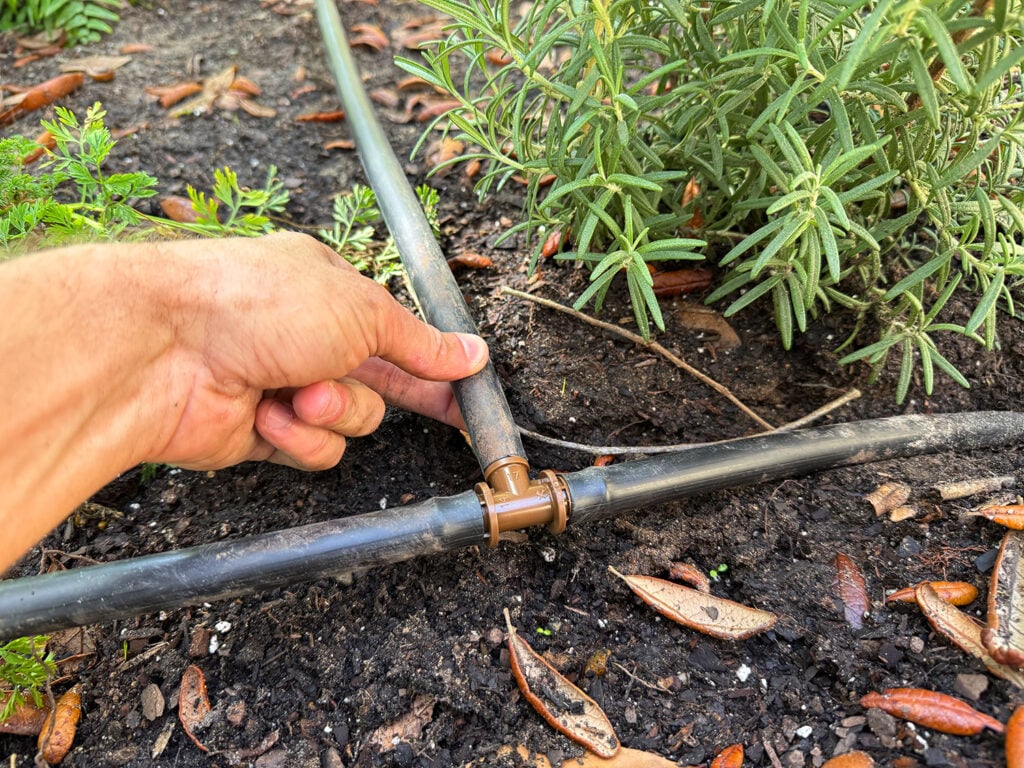
Be sure to clamp any ends of your main line tube closed with these ring closures. The kit includes 2 of these, so you may need to purchase more if you split your main line in more than 2 directions.
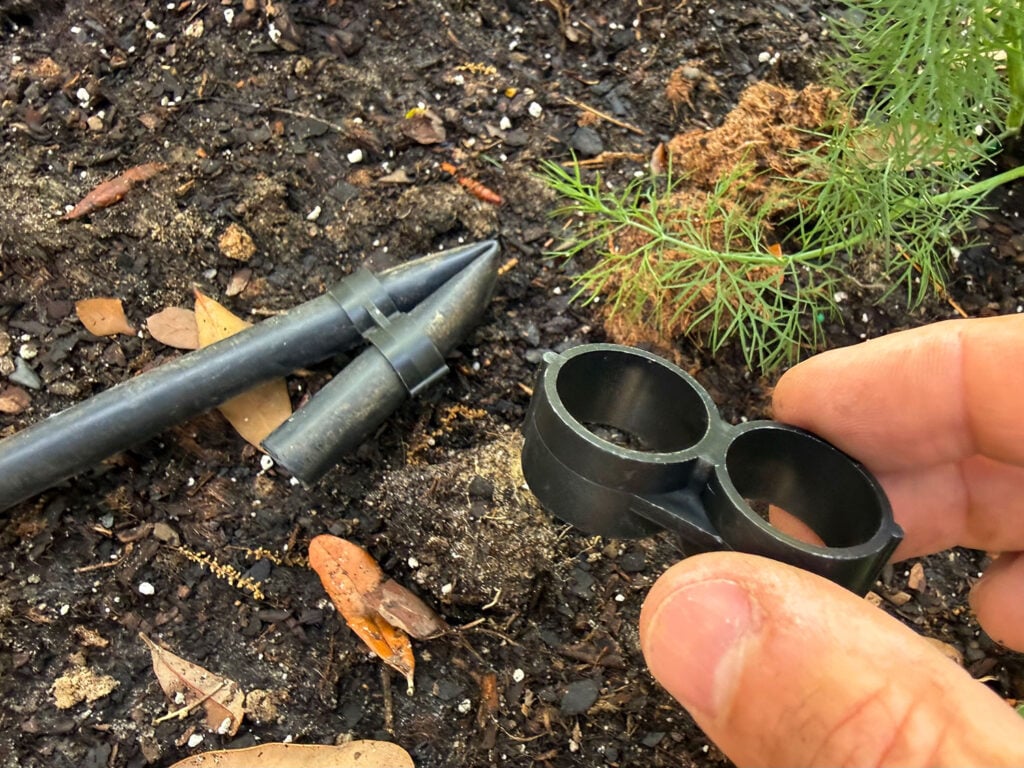
And when it comes time to shorten your main line, just cut off the excess. You can purchase a special tube cutter, but I found household scissors worked fine.
Step 6: Connect Driplines & Emitters
Next, you’ll be connecting driplines (1/4″ tubing) into the side of your main line (1/2″ tubing) near wherever you’ll be placing an emitter. Different types of emitters may require different connections, so don’t start making holes all willy-nilly.
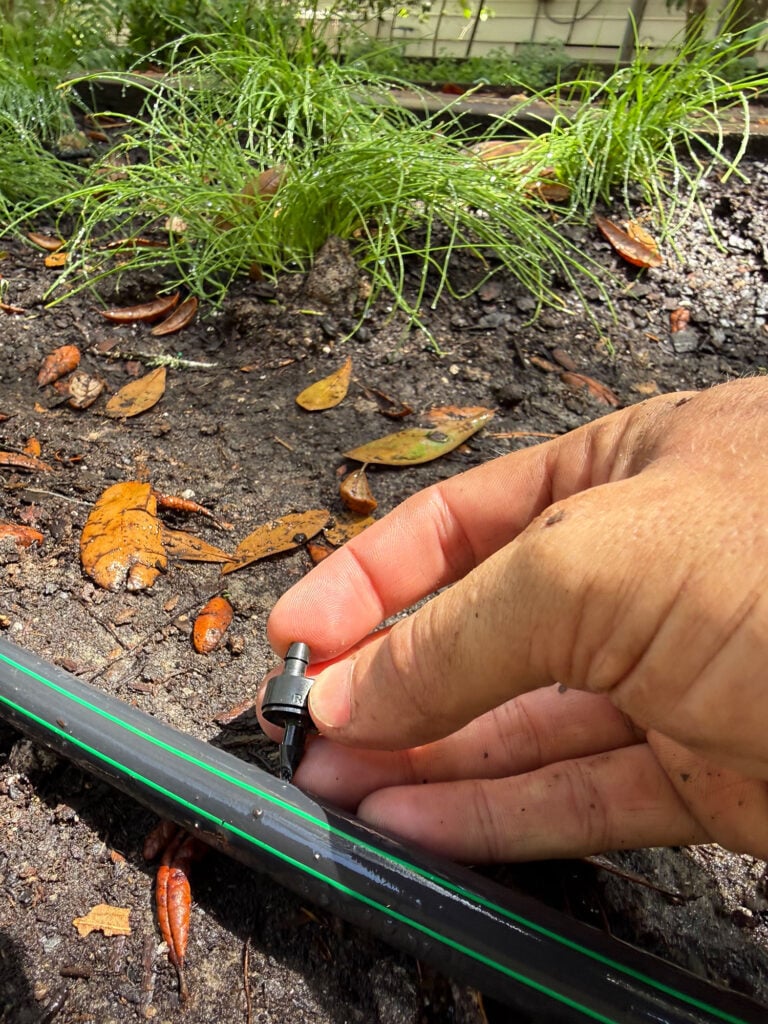
The bubblers and sprayers in this kit came with the correct barbed connectors attached. Just use pressure to puncture them into the side of your main line. The kit did include a tool to help with this, but I didn’t use it much.
For most drippers, you will poke them directly into the main line and then attach your 1/4″ tubing to the other end. If your dripline is quite long, however, it’s recommended that you install the dripper somewhere within the dripline (ideally within 5ft of the plant). Just cut the tube using scissors and attach the dripper between the cut ends, making sure the correct end faces the water source.
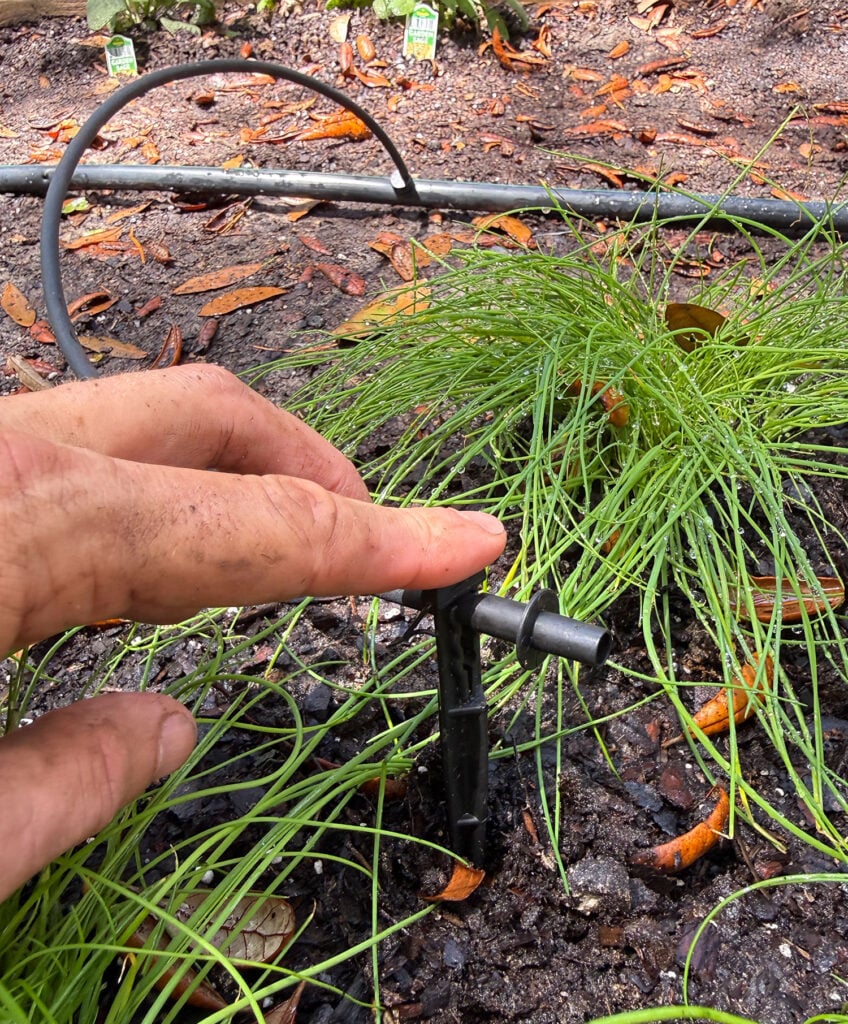
Finish off any of these driplines with a tube stake that will keep your water running exactly where you want it.
How To Correct Mistakes
Oops, you poked a hole in the wrong place? Don’t fret! The kit comes with several “goof plugs” which can be used to plug up the end of 1/4″ tubing or any small holes you make in your main line. If the hole is too large for a goof plug, you may need to cut the bad section out and use couplings to install a bit of new hose.
One warning, though. Once you place any barbed end into the 1/4″ tubing, it can be tough to remove. You may just need to cut off the errant piece and use another. Nothing is too complicated though. I made plenty of mistakes and was able to have a great working system by the end of a few hours. Really, you can do this. It’s the opposite of rocket science.
Step 7: Test & Program Timer
Once you have all of your driplines and emitters in place, it’s time to turn on your water and test your system. Use this test run to:
- Check for leaks near your hose bib or in any of your lines. Tighten connections to fix any.
- Make sure all emitters are dispensing properly. Sprayers and bubblers may need to be twisted open to work.
- Refine placements and spray patterns. Make sure water is reaching the places you intended. Adjust bubblers and sprayer heads to change spray distances.
- Look for overlap or overspray. Move or adjust spray patterns if areas are getting watered by multiple emitters. Try to limit overspray on sidewalks, driveways, fences, and siding.
Once you are happy with everything, take a moment to program your timer. It is generally better to do 1 or 2 deep waterings a week (versus short daily waterings). Deep waterings that soak the soil encourage stronger, more drought-tolerant roots.
Step 8: Dig In or Mulch Over (Optional)
Lastly, you may choose to dig in or apply a layer of mulch (or soil) atop your hoses. This is optional and purely for aesthetics, although some coverage can protect hoses from damage. Just be warned that burrowing rodents like moles may chew through buried lines looking for water. And buried lines may be harder to spot leaks in and repair. So in most cases, a thin layer of mulch is a good compromise.
More Garden DIY Projects
Want more ideas to upgrade or maintain your outdoor areas? Here are some other posts you might enjoy:
- How to Install Lawn Irrigation
- How to Make a DIY Vine Trellis
- How To Install DIY Landscape Lighting
- A Beginner’s Guide to Pressure Washing
- How to Strip A Wood Deck for Stain
- How To Stain & Seal A Deck
- How to Protect Plants From Freezing
*This post contains affiliate links, so we may earn a small commission when you make a purchase through links on our site at no additional cost to you.
