It’s October 15th and that means we’re back to share some earth friendly info courtesy of Almost-Doctor Dan for Blog Action Day 2009 (click here for more details on the big event). Since we consistently cover ways to live greener and give back to the planet (we have an entire section devoted to Eco Living on our How To page) this little online event seemed to fit right in, but we really wanted to go beyond ever-present eco encouragement like “use CFLs!” and “don’t forget to recycle!” (which are both great suggestions, they’re just a bit tried and true). So we looked no further than my brainy scientist brother to see what sorts of things came to mind on the subject of energy and how to conserve it (along with your hard-earned cash of course).
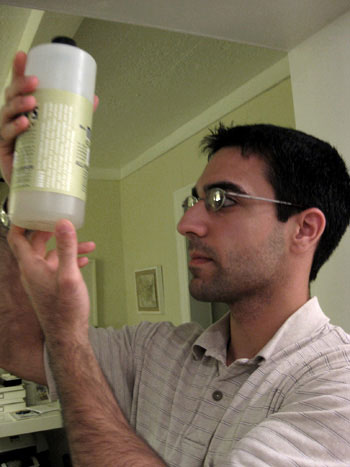
For those of you who aren’t familiar with the genius that is my brother (growing up in his shadow was tough but I survived), here’s a brief synopsis of his brain power: we introduced him here (and revisited his giant brain here and here), basically he went to Cornell and graduated with the highest GPA of his entire graduating class (a 4.21 if you’re wondering). Yup, out of all of the kids in Cornell’s College of Agriculture and Life Sciences, he was the Valedictorian. Yeah, he’s brainy. Now he’s a graduate student at Columbia with a Master’s degree under his belt, steadily working his way up to his Doctorate in chemistry with a full scholarship from the National Science Foundation. Not only do they pay for his education but they actually pay him a stipend for rent and food- all in return for wearing a lab coat almost 24/7 and messing around with molecules and polymers all day. Sweet deal huh? Serious Einstein stuff going on.
So we thought he was definitely up for the task of bringing something new to the table when it comes to saving energy and explaining the science behind his suggestions. And he didn’t let us down! In fact a lot of his save-energy strategies will also simplify your life and save your moolah. What’s not to love? Here’s what Almost-Doctor Dan had to say on the subject:
Tip #1: Water boils at 100 degrees Celsius, regardless of how fast it is boiling (changes in altitude or substances like salts or sugar dissolved in the water have a slight impact on this, but it’s really quite small). Every time you make pasta, hard-boiled eggs, corn on the cob or anything that requires boiling water, the food cooks at exactly the same rate whether the water is at a rapid, rolling boil or just a simmering boil. Most people aren’t aware of this and waste a lot of gas/electricity converting water to steam without cooking their food any faster (in fact, here’s a usatoday.com article that agrees once water begins to boil, all of the energy being added by the stove goes into turning water into vapor, not into heating the water). In short: a simmering boil should be the goal since you can save substantial gas/electricity by keeping your water from boiling too rapidly (which doesn’t change the time that it takes to cook things at all).
Tip #2: Along a similar vein, the hottest part of a flame is right at its tip. When using gas burners, if your flame has a larger diameter than the pot you are heating, you are wasting most of the heat produced by the flame, since it’s just going around the pot. A smaller flame that is completely under the pot will heat it faster and more efficiently than a larger one that protrudes from underneath. In short: make sure the pot you’re heating doesn’t have flames licking out around it or you can be sure you’re wasting gas and producing unnecessary heat that isn’t doing a thing to whatever’s in the pot.
Tip #3: A lot of people make a big deal about using less AC in the summer to save electricity. In the northeast, anyway, about 5-10 times more energy goes into heating homes in the winter than cooling them in the summer. Think about it – if an average summer day in NYC is 80 degrees and you use your AC to make it 70, you are using enough energy to maintain a ten degree differential between inside and outside. If an average winter night is 30 degrees and you use your heat to make it 70, you are using enough energy to maintain a forty degree differential between the air inside and the air outside (this is actually way more than four times as much energy, since the energy transfer is faster when the differential is larger so you are using exponentially more energy). In short: setting thermostats a few degrees lower in the winter can save a lot of energy/money, and raising it in the summer isn’t a bad idea either.
We also dropped our friend Kristin a line (she’s another Almost-Doctor who’s getting her degree in Germany, first mentioned here) to see what she suggests since this is also something she has studied. Here’s what she had to say on the subject:
At my department, we’re trying to make blue-green algae produce hydrogen by sunlight energy – which would be a great future energy source if we could get it working (no major breakthrough yet, but we’re doing our best). But of course, there are many small things that anyone can do in their everyday life to make a difference without breaking out their lab coats and beakers.
First there are some tips that are quite well-known, just as a little reminder:
- Keep your windows closed and well sealed in the winter
- Consider using a clothesline instead of a dryer (or air drying just a few things a week to cut down)
- Compost kitchen scraps to reduce waste and the need to buy fertilizer
- Install a programmable thermostat to save money and energy
- Plant fruits and vegetables in your garden instead of just flowers
Then there are a few more tips that are directly connected to climate change and greenhouse gas:
- Use furniture from local wood (try to avoid tropical wood such as teak when you can)
- Eat seasonal fruits and vegetables from local farmers
- Eat less meat (cattle produces methane gas when digesting their food, which is a far more potent greenhouse gas than carbon dioxide)
- When it comes time to replace your heating or water system, get informed about energy-saving possibilities which can actually save you money in the long run (you can install a heat exchanger, insulation or solar panels which can be hugely efficient)
And then there are some things that are advertised as eco-friendly but are not – or at least, they’re less earth-conscious than you might think:
- Local (but unseasonal) fruits and vegetables – surprisingly they are not always better than imported ones- I can only speak for Germany, but here scientists calculated that cooling local apples for three months or more actually calls for more energy and thus produces more carbon dioxide than transporting fresh apples from Chile or New Zealand (which don’t have to be cooled for three months). Only when your local vegetables are seasonal can you can be sure they produce as little carbon dioxide as possible.
- Bioethanol, biodiesel or any “biofuel” for your car – many rainforests are cut down to create farmland for corn, oil palm etc. Good future energy sources for cars might be electricity or hydrogen, as both of them can be produced using fossil as well as renewable energy sources, so the same car with the same engine can be used before and after the switch (which means less waste).
- E-recycling – thinking about recycling your computer is a good thing since the metals (aluminum, copper etc) are released from the hardware and reused, reducing energy consumption and thus global warming. However, most e-recycling takes place in India, where millions of people do this work for little money with little or no protection (meaning they literally cook the hardware, releasing not only the metals but also arsenic, lead and other toxic components which poison the workers there as well as the air). I don’t know of an alternative for broken computers, but try to use yours as long as possible (and sell or donate them to people who cannot afford a new one for a much more beneficial take on “recycling”).
In short: Kristin isn’t suggesting that no one eat meat and that everyone get solar panels. But if each of us took one or two tips and subtly worked them into our lives (like enjoying a “meatless Monday dinner of pasta or pizza for example, or letting large items like comforters air-dry instead of running the dryer for hours) we really could save money, live better, and help make a difference. Even remembering to do something as simple as using craigslist or freecycle to give our old electronics a second life or choosing to enjoy the most seasonal fruits and veggies that they have at the store (or the farmer’s market) will make us feel good and do the world some good at the same time. Remember: every little bit counts! And we’d love to know if you guys are doing anything else to help save money and the planet while you’re at it. Do tell!
Psst- if you’re looking to really make a dramatic change, check out this video and take on the no-impact challenge right here. It’s not for everyone, but it certainly is inspiring to hear about how living so simply can be so rewarding!

Bethany says
First of all, thanks for all of the wonderful tips. Very informative! Secondly, thank you for letting us know about Blog Action Day. My husband is the blogger in the family and has joined the ranks of those who are doing their part to help the cause today.
Tiffany says
I love that you oh so subtly remind people that you’re not asking them to change their entire life..just a few simple things make a difference if everyone chips in. I struggle with getting my friends to get that concept. I believe one person can make a difference.. and in this case one blog..yhl. Thank you so much.
Marian says
I am sorry. Tip #3 is not correct. If it is 30 degrees outside your home will not be 30 degrees inside. You are not taking into account insulation, the big fireball we have in the sky during the day, etc. AC is also much less efficient in cooling a home when it is hot outside than heat is at heating your insulated home when it is cold outside. Your lovely example would only apply if you lived in a cardboard box my dear and you did not exhale warm air or produce body heat.
Also, your energy estimate of 5-10 times more in the winter is probably because not everyone has AC but everyone has heat or space heaters.
YoungHouseLove says
Hey Marian,
Almost-Doctor Dan didn’t say that it would be 30 degrees in your house, he just said that “if an average winter night is 30 degrees and you use your heat to make it 70, you are using enough energy to maintain a forty degree differential between the air inside and the air outside.” Of course the air inside a home would never be 30 degrees if that’s the temp outside (with body heat, insulation, etc) but the point is that your system will be working much harder to make up for the extremely cold temps outside than it would on a summer day when it’s only 10 degrees hotter outside than you want to keep your house.
In addition, Almost-Doctor Dan didn’t get into the fact that “air-conditioning is inherently more efficient than heating (that is, it takes less energy to cool a given space by 1 degree than to heat it by the same amount)” but you can read more about that here: http://www.wired.com/science/planetearth/magazine/16-06/ff_heresies_02ac. It’s just another reason why reducing the temp on your thermostat in the winter just a bit can majorly save energy (and money to boot). Hope that helps clear things up for you!
xo,
Sherry
Marian says
You are not using energy to maintain a 40 degree differential Sherry. Your home’s insulation is doing a lot of that work. It takes less energy to keep a home at a steady temp regardless of the cold outside than it does to cool a home when it is hot outside and the sun is out…
xo,
Marian
YoungHouseLove says
Hey Marian,
The differential between the air inside and the air outside would still be 40 degrees, which is all Dan is pointing out, not that your air inside would be 30 degrees, just that the same insulation that would pad that differential would also pad the ten degree differential in the summer, so clearly the house would still work harder to make up for a larger temperature discrepancy.
I’m not sure if there’s an article that you can link to that says that it takes more energy to cool a home when it’s hot outside (did you check out the one we linked to that said the opposite? you can see that url in our response above) but by personal experience I know that we use heat in the winter faaar more than we use air conditioning in the summer (and we spend hundreds more on heating than we do on cooling even though we live in the south with extra long spring, summers and falls and winter is only around 2-3 months here). Perhaps you live in a totally different climate than us?
xo,
Sherry
Trina says
Set your thermostat at 65 degrees in the winter and only turn it up when you are home and want it warmer…. biggest waste of energy is a home’s huge flux in temperature. Period.
AC is wasteful. Keep blinds and windows closed during the day and open them all at night to use cool air to cool home. Only use AC when you have to. Sun outside in summer heats air outside and inside your home and beating sun on windows raises temp of your home. AC can’t combat that. AC uses way more energy to keep home at cool temp then heat does to warm a cool house.
YoungHouseLove says
So true Trina! Thanks for stopping by with those extra tips!
xo,
s
Kevin M says
Thanks for this blog post. I just wanted to add that this past weekend I painted 2 rooms of our home with Olympic Premium paint – it is no VOC and had great results. It is a little pricier ($5 a gallon I think) than the normal Olympic paint, but a price I gladly paid to avoid the stinky fumes.
YoungHouseLove says
Hey Kevin,
Thanks for the paint tip! We have yet to try that brand from Olympic but the no VOC thing sounds totally worth a little extra dough.
xo,
s
Christa says
I think Kristin’s tips are great!! Not sure I am buying the others… To each their own ;)
Jenni P says
I’m loving Almost-Doctor Dan’s tips! How can you argue with science? No more over-boiling my water, firing up my gas range too high and raising my heat. I’m a changed woman! Great post YHLers!
Marian says
What is quoted in the article is not a home in our environment. That is in fact true of a box in a lab heated by a bunsen burner… We are talking about a home here and day/night climate in the winter versus summer. I live in the same climate as you. My home is new so it is most likely better insulated and our heat/cool central air is new as well so that may explain our difference in experiences. That is a bummer you have to use so much energy during the winter.
This is the second post of this kind I have had a problem with and might have to say farwell to YHL. I very much enjoyed your home improvement posts over the past year…
YoungHouseLove says
Hey Marian,
We’re very sorry that you have a problem with this post but we blog about things that we’re passionate about: home improvement, decorating on a dime, being kind to the planet, sprucing things up on a serious budget and generally living well and learning as we go. Almost-Doctor Dan’s tips were heavily requested in our recent reader survey but that’s not even why we went to him for Blog Action Day, we turned to him and the lovely Almost-Doctor Kristin because we love to learn and do our part to make whatever small difference we can. We don’t expect that everyone will agree with everything that we share on our blog but we do plan to keep covering topics that interest us and keep us excited because we truly believe that’s what has gotten us here today! We hope you understand and we respect your decision, whether it’s never to come here again or to continue to drop in on us.
xo,
Sherry
Katie says
Great tips! Thanks for devoting so much of your blog platform to helping educate others about easy ways to become a little more green.
I also really appreciate how respectful you always are of other opinions and your thoughtful, kind, and prompt responses :)
Sherri says
http://www.newton.dep.anl.gov/askasci/eng99/eng99577.htm
you have to compare the same change in temp to really compare. You have to take into account sun, insulation, heat pump heat produced, appliances in home on such as TV producing heat, etc. On a hot day sun heats home constantly while thermo trying to cool.
Most new home heating cooling systems have central air so they re-heat air in home or re-cool air in home rather than constant bring air from outside in. Warm air in a home takes less energy to heat than the 40 degree differences you are claiming. You are not considering homes or how these systems work. You can’t make this claim based on something done on a lab bench.
YoungHouseLove says
Hey Sherri,
Thanks for the link. The purpose of this post was just to make people aware of small changes they could make to use less energy and we still believe that lowering your thermostat a bit in the winter is a great tip. How could it not be? Of course Almost-Doctor Dan can’t account for everyone’s different heating & cooling systems or the amount of insulation that each house has, but we still wholeheartedly believe that his point is just that a house has to work extra hard to maintain a certain temperature when the air outside is dramatically different. And because there are more dramatic differences between the temps that we want our house to be and the outdoor temps in the winter in our climate here in VA, it still makes perfect sense to us- not on a lab bench but by personal experience (as we mentioned above, we spend hundreds more heating our house than we do cooling it although the winter is extremely short and the summer can drag on and on).
Again, our intention here was to toss out a few simple suggestions to get people to cut back a bit here or there (like enjoying a non meat meal once a week- pizza and spaghetti? yes please- or even craigslisting their computers) and even if 10% of our readers adopt one little change we’ll be thrilled. By no means did we expect everyone to adapt each idea to the letter. Hope it helps keep things in perspective!
xo,
Sherry
patti says
just adding my 2 cents…i live in sacramento, ca. it gets very hot for many months throughout the year and we spend a ton more on air conditioning to cool the house than we do on heating the house in the winter months. we have an older house (built in 1939) and our bedrooms are on the second floor in a converted attic. it’s the hottest place in the house. last year we installed new insulation and also put an attic fan in the crawl space. we noticed a slight difference in how hot the upstairs would get, but still, it’s hard to go to sleep when your room is still upwards of 90° at 10pm.
another thing we did was install separate ac/heating for the upstairs – meaning we now have a two zone house for controlling the temps. this works nicely for us to be able to control the temps in the areas of the house we need to.
we are investigating getting a whole house fan. we’ve heard from neighbors that have them that it is a great cost effective solution because you can run it at night and open up the windows to help pull in cool air and push out the hot air. do you have any opinions on the whole house fan idea? just wondering if it’s worth the one time big expense to install.
we don’t have much problem in the winter we just add more blankets on the bed and keep our house pretty cool – around 68° and lower when we go to bed.
YoungHouseLove says
Hey Patti,
That makes perfect sense! Almost-Doctor Dan was talking about NY weather, and even here in the south we have a far higher challenge of heating out house than cooling it, but we totally agree that if your California weather is much hotter it would definitely effect the energy and money you spend heating and cooling your home. We love the idea of installing separate ac/heating systems for each floor (efficiency like that makes my heart go pitter patter) and we also have heard that whole-house fans are super amazing when it comes to having an even more efficient and comfortable home. Definitely let us know how it goes if you get one. We’re jealous!
xo,
Sherry
Lindsay says
I think a great take away from the AC versus heat is energy hog is that decreasing your furnace temperature in the winter and increasing your AC temperature in the summer is a great way to save energy and (woohoo!) oodles o’ moolah!
If you’re cold in your house in the winter, throw on a sweater! If you’re hot in the summertime, go to the movies! Don’t just immediately turn up/down the thermostat.
Thanks, Sherry! Great post today! Happy Blog Action Day ’09!
YoungHouseLove says
Amen Lindsay! Amen.
xo,
s
Virginia says
First, I want to say I enjoy your blog and read it often. You guys have an amazing platform here to reach a lot of people.
Not to criticize, but I feel like the science stuff is very different from the design stuff, which is more subjective. If you want to bring in experts, bring in experts.
I wonder if Marian’s concern is similar to my own, when I read your posts on energy/science tips – when you make the case that these tips are scientist and/or doctor-endorsed, unless your scientists are specialists in the areas they’re opining on, I think it’s fair to say these are reasoned opinions, but they are being passed off as fact.
It almost seems like these tips would be better coming from you guys – this is an area of interest to you all that you’re passionate about, these ideas make sense to you. . . I think when you imply that a scientist or doctor or almost-doctor is behind an idea b/c of “x”, and “X” is rebuttable, it’s easy to discount that other ideas may be good ones.
YoungHouseLove says
Hey Virginia,
That’s funny to us because we’ve learned that everything we blog about is subjective. We’ve seen people disagree about everything from color pairings and brick-painting to being green and the boiling point of water! I think the thing we’ve learned from over two years of this old blogging thing is that everyone has an opinion on almost everything that can be blogged about. We know that we can’t possibly embody every single belief of every single one of our readers when we post two times a day, so we’ve learned to respect everyone’s right to their own opinions and just keep writing about what we feel is important. Going into Blog Action Day our only intention was to share helpful tips that might help a small percentage of people make teensy little changes for the better, and although it seems as though a handful of people are upset about one small point in this one post out of over 1000 that we’ve written we’re still extremely happy to be involved with Blog Action Day and we’ve learned that you just can’t please 100% of the people 100% of the time.Of course that doesn’t keep us from trying!
xo,
Sherry
Brittany says
Loved the post! Great tips that aren’t just the same ones you hear every day! I also appreciate your timely, thoughtful responses to everyone’s questions and concerns, and how respectful you are of other’s opinions. Keep up the terrific work!!!! : )
Bethie says
Typo alert: You’re missing an “r” on the word “winter” in tip three!
Great post by the way!
YoungHouseLove says
Thanks Bethie!
xo,
s
lindseykaye says
Love the tips – thanks for reminding me about over-heating water when cooking. One little thing that is so easy to put to use in our daily lives.
To add to the heating/cooling discussion; all those factors listed as “missing” from your calculations are constants.
A house would have the same insulation, cooling system, occupants, daylight hours, etc in the winter and the summer. Therefore they can be left out of the equation entirely. The temperature differential is still greater in the winter.
Newer A/C units that recycle in-house air are great, but I don’t think they’re too common, and the advice is still going to save a little energy either way.
YoungHouseLove says
Hey Lindseykaye,
Very true. We also think that’s one of the reasons Dan left that extra info out (as it would be the same every day of the year regardless of the temps outside). He’s also famously direct, no extra words necessary for him. Hehe. Anyway, thanks for pointing that out!
xo,
Sherry
Kristin says
Hi Sherry and John,
nice to see that my suggestions are finally online – I nearly forgot it’s Blog Action Day today! (In fact, it just turned friday in germany).
Of course, tips on scientific-related topics can be as subjective as design posts, especially when talking about very complex themes like energy efficiency (the AC and heating topic – very complex to calculate in detail, I think, but Dan’s point on temp difference is correct of course). Scientists keep arguing about it as well. So everybody, please feel encouraged to get informed and build your own opinion! Of course it’s nice if someone shares my opinion, but if this post just gets some of you to read and think about its, it has done its job.
Kristin
YoungHouseLove says
Thanks Kristin! We totally appreciate your brain power on this. Happy Blog Action Day to ya all the way over in Germany!
xo,
Sherry
Leigh says
Thanks for the tips! Just a little correction that may be causing some confusion for Americans. Water boils at 100° Celsius. Since Fahrenheit is the standard here, some poor girl trying to go green could be sitting over her tea kettle wondering why the heck her 100° water isn’t even steaming. 212°F is the magic number here in the US.
YoungHouseLove says
Hey Leigh,
Good clarification! We added Celsius in there just now. Thanks!
xo,
s
Asia says
The stuff people will flounce about is so ridiculous. I’m still here and lovin’ you guys <3
erin says
I’m surprised no one mentioned the value of trees in our environmental impact. Not only are trees just plain good for the planet (producing oxygen and consuming carbon and the like) but properly placed deciduous trees can also provide valuable shade for a home to cut down on your summertime energy costs. I grew up in sunny inland San Diego, and we had two huge fruitless mulberries that shaded the entire southwest side of my parents’ house in the summer. We never had air conditioning, and that shade combined with being careful about keeping shades closed and opening windows in the evening to cool the house made it always feel as if we did. Of course, the leaves dropped in the fall, so during the cooler winter months the sun passed right through the branches to warm the house.
I now live in Sacramento like Patti (and am coveting her zoned AC!) and can attest that we definitely spend MUCH more energy in the summer cooling our home. I’m convinced this is because we don’t have [mature] shade trees on the west side of our home, since the climate is pretty similar to inland San Diego. Our local utility company will even provide up to 10 free. Shade trees are a VERY easy way to save money on your energy bill AND positively impact the environment.
YoungHouseLove says
Good point Erin! Trees are both lovely to look at and very handy indeed for providing everything from clean air to shade and insulation to keep your house more comfortable!
xo,
s
Ali says
Oh my, I don’t understand all of the drama that these eco-friendly posts stir up. I would have assumed that most people could form their own opinions about what they read; it’s not like John and Sherry are brain-washing us. Maybe I am giving people too much credit. Sheesh…
Anyways, great post. I think the take away from this is that we can all do small manageable things. In fact we NEED to all start contributing more.
Caitlin says
I love the eco-related posts! You don’t try to shove anything down our throats, so just ignore the haters who whine about these posts. If the videos stay because some people like them even when others don’t, these should stay because some people like them even though other’s don’t.
If people have issues with Almost-Doctor Dan, a nice tongue-in-cheek yet informative moniker, then they are taking this blog (and themselves) way too seriously.
Alyssa says
Hi guys… love your posts, wish I had time to incorporate many of your ideas, oh well.
I just wanted to comment briefly on the statement regarding “e-cycling” as being not as environmentally friendly as you might expect. I work for a large electronics company, and my entire job function is centered around complying with international environmental regulations for products (not trying to toot my own horn, just trying to show i spend forty plus hours a week dealing with this stuff). Especially in Europe (but it is spreading to Asia, South America, and slowly but surely the US) there are an immense number of regulations that are centered around how companies need to take back the electronic waste they produce, and how they may not transport this waste to less economically successful countries for dissassembly and reclamation. Additionally, the electronics industry is working everyday to decrease the amounts of hazardous materials content in products, and there are more reporting requirements than ever. That being said, being concious of all types of waste you are putting into the environment is important. Just wanted your readers to know that the statement is not always untrue, however it is certainly not the norm, and hundreds of people like me are working to make sure we are doing as much as we can to prevent this type of activity….
Happy blog action day! keep up the great work!
YoungHouseLove says
Hey Alyssa,
We’re lucky to have people like you looking out for people’s safety and helping to recycle electronics in safe and efficient ways! Thanks so much for sharing your story!
xo,
Sherry
Meredith K A says
Eating less meat isn’t just environmentally friendly because pigs, cows, poultry, and lambs produce methane; raising animals to eat is a much less efficient process, because they have to eat lots of crops to grow before we can eat them, so for example instead of me eating veggies that cost some fossil fuels to grow, those fossil fuels are used to grow crops to feed animals, and then MORE fossil fuels are used to continue raising those animals until they are sold as food, so A LOT more energy goes into raising meat than into raising fruits and veggies. To be sustainable, we just have to eat less meat, not no meat.
Re: the dryer versus air drying: I’ve found that my clothes get completely dry in the same amount of time even if I use the lower heat setting on my dryer, so now I never go above medium heat, and often use the lowest heat setting to try my clothes. I imagine it’s similar to the concept with the boiling water – no need to keep it at a rolling boil, a simmer is fine; similarly, it’s the tumbling that’s doing most of the work, and the water is already evaporating as fast as it can, so increasing the heat won’t speed things up any more. I wonder if Almost-Doctor Dan would agree?
annie says
Simmering isn’t boiling. Just because bubbles are forming doesn’t mean that the water is fully 100 degrees Celsius, only that the water touching the bottom of the pan is 100 degrees. A simmer can start when the bulk of the water is as low as 82 degrees. If you’re trying to cook pasta in a simmering pot that’s 10-20% cooler than boiling, it’s going to take 10-20% longer cook. Also, due to the drop in temperature once you put food in, lower flame/heat means it will take longer to return the contents to cooking temperature.
YoungHouseLove says
Hey Annie,
Almost-Doctor Dan’s point was not that a low simmer would cook things just as fast, but that “a simmering boil” would (as opposed to a raging one that wastes energy and heat converting water to vapor which does nothing to increase cooking time as discussed in this usatoday.com article). The idea is just that you don’t need an insanely crazy boil and that a mediocre one will do just as well. Again, our intention with this post was to toss out a bunch of little things people could choose to do if they would like. We’re not trying to force anything on anyone; we just wanted to share information and ideas in the hopes that maybe one in ten readers might be able to make one small change for the better (like lowering their thermostat two degrees while they’re sleeping or laying their comforters out to dry instead of running the dryer for hours). Hope it helps!
xo,
Sherry
Bethany says
Yikes! Who knew that this would cause so much controversy. I am with all the others who agree that you’re doing a wonderful thing with your blog. What a brave thing to let the world have access to so much of what most of us keep private. I really appreciate all that you do.
Meredith K A says
Lindseykaye said one of the main things I thought when reading the inexplicably angry posts: you have insulation in the summer too, and it helps keep you house cool just like it helps keep it warm in the winter.
The only other difference that no one has mentioned explicitly is the sun: in the summer, it’s working against your AC continually adding more heat by beating down on your house, even if you have the blinds closed; in fact, if you did nothing, the sun could even make your house actually hotter than the air outside, so the AC is potentially overcoming more than just the 10-20 degree temperature differential between the air outside and the desired temp inside.
So in the winter, regardless of the type of heating system or insulation or anything else, the sun is helping you out – it’s still adding heat to your house, regardless of the temperature outside, and so your heating has less to overcome than a 30-40 degree difference, because some of that work is being done by the sun (whereas in the summer ALL of the work has to be done by the AC).
But it’s still true that the higher difference between the outside and inside air causes your house to lose heat more quickly in the winter: any high school physics student can tell you that, it’s inherent in the equations! Yay for math! So my guess is that it depends on the type, age, efficiency of your heat and ac, and the insulation, efficiency of windows, attic fan, location of trees, etc at your house, whether the heat loss in the winter from temp differential versus the heat gain in the summer from the sun leads to your heat or your ac being the more energy-consuming system.
Also, SPENDING more $$ doesn’t necessarily equate to how much more or less efficient heating vs. cooling is: our apartment had electric AC (of course), but gas heat, and gas was cheaper, so it was more expensive in the summer. But now we have 100% electric, and we know from the previous owner that it costs more to heat in the winter than to cool in the summer.
But of course, turning down the temp + adding a sweater in the winter, and turning up the temp + having an iced drink in the summer are ALWAYS going to save you energy and money, regardless of which system is less efficient!
YoungHouseLove says
Hehe, you crack us up Meredith. Yay for math indeed! As we mentioned in a few comments a while back, it certainly depends on your system, the amount of insulation you have, your placement of trees etc, so Almost-Doctor Dan can’t account for all those variables, but in general the idea of turning down the temp in the winter and turning it up a few degrees in the summer certainly can’t hurt (and it’ll save you money to boot). And we totally agree with you wear-a-sweater approach as well. We definitely bundle up around here to save a buck!
xo,
Sherry
jo says
holy smokes! i give you guys uber props for being so respectful of some of these ridiculously nitpicky comments. someone is going to stop reading your blog because of an eco-friendly post?!?! craziness.
i LOVE these posts and find them endlessly informative just as i do your design posts. keep up the incredible work. i will be a loyal fan…unless you start posting, say, DIY baby seal clubbing and then, and only then, will i remove you from my blog roll :)
YoungHouseLove says
Hehe, thanks for the laugh Jo. We cover a range of topics but we can promise you that a baby seal clubbing tutorial will never be one of them!
xo,
s (& j)
vicki says
Love all the posts- design, puppy or Dr Dan– keep up the good work!! (and ignore the know-it-alls)
I do have a question that I would love someone to discuss– we have a programmable thermostat– we have it set to drop during the hours we are at work and then an hour before we come home it goes up to 68 degrees and then at midnight it drops to 65 degrees and warms up for the morning rush—
Is this saving us anything?? Is it making our heat pump work overtime thus raising our energy costs because we want it to increase in temp in a one hour time period??? Ahh so many questions but with heat bills out of control it would be nice to know if I am doing anything right here!
YoungHouseLove says
Hey Vicki,
Great question! We’ve seen a ton of articles on the subject (many of which don’t entirely agree) but the majority of experts do seem to be aligned in the belief that programmable thermostats are the way to go. In fact The US Department of Energy estimates you can save 10% on your heating bill by rolling back your thermostat 10-15% for just 8 hours (for example, overnight). Imagine the extra savings to be had by lowering the temps while you’re at work as well. A lot of programmable thermostats say right on the front of the package how much you can potentially save as well (usually around $300 a season) if you follow their setting guidelines (which are right about where yours are at 65 at night and 68 when you’re home). If anyone else knows more on the subject we’d love to hear it!
xo,
Sherry
Kate says
One huge, easy, healthy and conscientious way to be more ‘green’ is to become a vegetarian. Think about all the soil erosion, deforestation, and green house gasses released from cows that could be greatly reduced if we all just ate less meat. Besides, think of the animal cruelty, but that’s another subject.
Erica says
I’m with Asia and Bethany.
I think its incredible that you allow people into your home and share things with us that most people would consider private. I feel like sometimes we can all get a little greedy (myself included), its almost like what you give us is never enough and we’re always wanting more from you guys. Yet every time, you guys pull through with more house details, responses to criticisms about why you did this and not that, answers about your personal life and about why you wear your hair in a pony tail or when you’re having a baby. Geez, I can’t imagine getting all that thrown at me!
It makes me mad that people jump all over your case for something so ridiculous, especially after all you’ve done for us readers…weekly freebies, layouts of your home, DIY videos, etc. I truly appreciate what you do and I’m glad you don’t let people ruffle your feathers too easily!
YoungHouseLove says
Aw thanks Erica! It’s comments like yours (and Asia and Bethany’s) that make us grin all day long. We know by making our lives public we’ve certainly opened ourselves up to criticism and more than a few probing questions, but blogging is what we love so we wouldn’t rather be doing anything else. And it has taught us to have thicker skin, to write about what we believe in, to respect the opinions of others (after all it’s totally unrealistic of us to expect everyone to agree with us 100% of the time), and to take pleasure in all the kind comments and letters that we receive. Thanks so much for your sweet support!
xo,
Sherry
Erica says
Now that Vicki brings it up, Sherry I meant to ask you what programmable thermostat you and John have? Or maybe if you’ve heard which brands seem to be the most user-friendly? I remember seeing it in one of your posts but I can’t seem to find it! Now that we’ve turned our heat on, we’d like to buy one so we don’t have to manually turn it up and down every day. Thanks!
(And I hope my previous post didn’t violate your drama-free policy below! Sorry!)
YoungHouseLove says
Hey Erica,
Good question! Here’s a post all about how we switched out our thermostat for a new programmable one by Hunter (it wasn’t even that hard!). Hope it helps!
xo,
s
Julie says
Just wanted to compliment you for the grace and respect you give to all readers, no matter their opinions or tone on delivery. Props!
Jenny @ Making the Most of Money says
I love the mention of Craigslist in the last paragraph. I stalk the Craigslist pages for weeks if I’m looking for a specific item in particular, until I find just the right thing. We furnished almost our entire apartment from there – second hand – and saved tons of money while doing it too. Once I have time to tidy up the apartment, I’ll be posting pics of it on my blog. I love Craigslist! (also, best time to look is during moving season, or if you live near a college, near move out/move in time)
Beth says
Sherry and Jon,
I love your blog and really appreciate how respectfully you respond to all your readers. It is a brave thing to expose yourselves to so many! Anyway, I think that these posts although apparently “controversial” at lease get people talking and thinking about the complex issues of climate change and the impact we have on the environment. And although Almost-Dr. Dan doesn’t have the PhD in his hand yet, he deserves props for being so diligent in his work and probably knows so much more about chemicals and their impact on our environment than I could ever hope to fathom! Thanks to you both and Almost-Dr. Dan and Almost-Dr. Kristin for taking the time to entertain and inform us!
Lisa says
Hello John and Sherry (and Almost Doctor Dan and Kristin!), thanks for a fantastic post, yet again! It’s refreshing to see eco-friendly posts that acknowledges that most people are not willing to change the entire way they live their lives, but that changing a few small things will still go a long way. I think sometimes people get scared away from doing “anything” because they’re all of a sudden expected to do “everything”.
It’s also nice to see an eco-friendly post that dares to touch upon the big no-no, that one of the biggest things we can do to be more green is to eat more green, and cut down on our meat consumption. The meat industry puts out more carbon dioxide than our cars do, yet it’s almost never mentioned as a way to change as it’s so cemented in our culture.
Also, well done on handling the drama in the comments, you guys were so polite and understanding, unlike the posters…
Thanks for being you!
Rebecca says
I have been wanting to write this for a while. I love your post, and what you are trying to do to repurpose, reuse, etc. There is just an elephant in the room that you have missed, in my opinion. Thankfully you brought it up yourself. Why haven’t you gotten a clothesline yet? Talk about a DIY project on the cheap that will pay for itself in no time! Do you realize that as much as 10% of household energy use comes from electric dryers (no matter what the setting)? The sun will do it for free!
You know that buge ball of lint that you pull out of the dryer everytime you dry a load? That’s your clothing! Wearing away. In countries where electricty is MUCH more expensive (as it will be here in the states very soon), the dryer is a last resort. There are so many ways to dry.
I personally love line drying clothes, gets me outside in the air, the sun naturally sanitizes the clothing. If you can’t line dry–you can still go a long way drying in doors, use your basement, a drying rack, etc. The smell is better than any synthetic smell degtergent companies create.
SO YHL, when will you DIY your clothesline? Seriously, a great thing to do for the environment, that barely costs anything…
There are communities that have HOA that prohibit clothes lines, because they look “poor”. That makes me so angry. Here is a website that is trying to change that attitude.
http://www.laundrylist.org/
YoungHouseLove says
Hey Rebecca,
Good point! We actually have an energy star rated high-efficiency washer that spins our clothes so swiftly that that they’re practically dry when they come out of the washer. Plus our dryer has a sensor to stop as soon as it “senses” that the clothes are dry, so often times it’s just 7-10 minutes and everything is warm, fluffy, and completely dry. Our electricity bills have actually been noticeably lower since getting them. That being said, we would definitely be open to going even greener with a clothesline, although we would hate for our new front-loading dryer to go to “waste.” We already lay out things like duvets, comforters, pillows, sweatshirts and jeans to air dry without ever tossing them into the dryer just as Almost-Doctor Kristin suggests, but maybe we’ll start thinking about an actual clothesline. We certainly enjoy composting and collecting free water in our rain barrel so it could be something that we end up loving. We can certainly see how line drying leads to fresh, lovely, and free clothes drying. Thanks so much for your thoughts!
xo,
s
Rebecca says
There is definitely a time and place for dryers. Some people can stand scratchy towels, for example and and definitely happens with towels on the line (although notably less so than when we switched to Charlie’s Soap a nice green alternative for laundry detergent), and once if it rains like it did this weekend, or once it gets really cold–it is worth running the dryer.
I don’t have a HE front loading washer, but it is definitely something I am saving for–along with an organic mattress. In this chapter of my life, a new clothesline is much more affordable than the machine. Still taking a nice evening bath, putting on fresh PJs and slipping into a bed with fresh line dried sheets, especially in the fall, is one of the best things in life!
Sorry to go on–it is something I get really passionate about. From my grandmothers clothes pin bag I inherited, with the most incredible clothespins that you can’t find anymore, to the art of how to hang it–I just hope that it won’t become a lost art!
YoungHouseLove says
Good to know. Thanks for all of your tips!
xo,
s
Audria says
An idea for reusing old computers that no longer work: donate them to a preschool or kindergarten class. We had a “business box” at our school with old keyboards and other items so the kids could play office. This was one of their favorite activities!
YoungHouseLove says
Now that’s adorable. We love that idea!
xo,
s
cailtin says
so glad someone mentioned trees! i have never had AC even living in pittsburgh’s balmy humid summers–and I have been lucky that every place I have lived in has been surrounded by trees. They were a major factor when I bought my home–definitely don’t need AC and my house is always cooler than the outdoor temp by about 10 degrees in the summer :)
Marcy Tate says
These are really good and useful energy saving and eco-friendly tips. I find that all over the web the same ideas are presented and this post offered some fresh new ideas like the water boiling and buying local, in season fruits and vegetables. Sherry- Your brother has a bright future ahead!! You should encourage him to open up his own blog- I would read it!
Tiffini S. says
Helpful Hint regarding clothes dryers: I use my dryer for towels, sheets, socks, and blankets. All (ahem) undergarments are hung on hangers directly after washing (I have a clothes rod installed in the basement near the washer and dryer, or you could use a portable clothes rod). All shirts, pants, and other clothing are put in the dryer for 5 minutes, just enough to warm them up, then I shake them well and hang them up neatly. I started doing this a while back for two reasons: 1) My fiance kept complaining that his clothes were “shrinking” so this helped him see that it wasn’t the clothes shrinking so much as his waistline growing. 2) It helps me conserve not only the energy I don’t use for a full drying cycle, but it makes the clothes remarkably wrinkle free so you usually don’t have to iron them. (Bonus points for being WAY easier than normal laundry!!)
YoungHouseLove says
Thanks so much for the tip Tiffini!
xo,
s
Lisa says
Marian needs to get a life. There are plenty of us who love your blog even if we don’t agree with everything you post.
salley says
as always, thanks YHLers for the tips- even if your readers sometimes take exception with the details, i think all the commenters support the general premise of conservation.
I just wanted to give a huge thumbs up to whole house fans. our house was built in the early 1950s and came with the fan so i dont know what it would cost to install, but it is an absolute life (and $) saver in the hot humid raleigh nc summer and allows us to rely on the AC a lot less. i’m no scientist, but i have good friends that work on building energy efficient buildings and they agree. the other thing they would suggest, and might be good for all your readers w/ different types of houses, hvacs and climates: check and see if your utility provider offers energy audits! in many places they are free- they’ll do a blower test and let you know where you need insulation, what windows are leaking etc. i’m looking forward to getting one soon.
keep up the great work!
YoungHouseLove says
Such great tips! Thanks for adding to the conversation Salley!
xo,
Sherry (& John)
Kate R says
Love your blog J & S. I started checking it out a few weeks ago, and I think it’s great :)
I try to do little things like you mentioned to make just a little difference. We close the vent and door to our guest bedroom since we don’t use it that often so it’s one less room we have to fully heat/cool. When we know we’re having someone stay with us, we open the vent and get things circulating in there again.
I also try to cook things in our toaster oven when possible instead of heating the big oven. And, when I use the big oven, I turn off the heat when there is 5-10-15 minutes left (depending on what I’m cooking) and let the food cook with all the heat that’s already in there. In the summer I try to make “cold” foods that don’t require much cooking, so we don’t heat up our house.
Also, for anyone lucky enough to build a new house, if you get a LEED AP (leadership in energy and environmental design accredited professional) architect, or just read up on your own, you can learn the best way to orient your new house, the best location for windows, etc to make your home more energy efficient.
Thanks for all you do for all your readers! (Have you done an update on your mattress? I’m curious on your feedback.)
sarah says
Well, this solves two arguments I had recently with my husband (faster boiling and higher gas stove). He won…both of them! Maybe I’ll get some kisses out of the loss. Here’s to smart brothers, sweet husbands, and green living…:)
Brandi says
Sherry..
I feel so horribly about how so many of the readers have posted negative comments about very basic scientific things..temperature differentials, etc. Your brother wasn’t trying to decipher everyone’s personal heating/cooling system dilemmas.. I have to applaud you for the respectful way that you answered their posts, and I’m not sure (after the second or third response) I would have been so nice.
As for Almost-doctor Dan’s credentials.. As I, too, am almost through my PhD in physiology, I can tell you that researchers do not learn things just ‘from a bench’ point of view. That’s not what we go to school for.. yes, things are tested and designed for ‘the bench’ at times; however, the ideology and theory behind what he is testing..it is from real-life issues. This is the same in any basic science or medical science field.. You learn to test things on the bench at times, but your education isn’t limited to or directed for ‘the bench’.
There are many years worth of education in his brain…
No worries… tell your brother thanks.. Chemistry is not my subject and any tips he can give are greatly appreciated .. :)
YoungHouseLove says
Aw thanks Brandi! Your kind words definitely made me smile and I’m sure Almost-Doctor Dan appreciated them as well. And congrats on your almost PhD!
xo,
s
Brandi says
Sherry..
No problem… I hate it that there was any controversy at all.. seriously. I love reading your blog!
Thanks… Hopefully I’ll have an ‘almost’ job soon!
Good luck to your brother.. I have nothing but awe and respect for ‘chemies’.. too much brains for me!! Just looking at a chemistry book stresses me out!
Nick P. says
The info about the stove burners was fascinating. I never knew! I agree with your comments about laundry equipment. Big energy savings can be had with the right combination on laundry equipment. The new front-load washers not only use less water, but they do not need hot water AND the spin the clothes out so fast that they come out almost dry.
We then just take those ‘almost dry’ clothes and hang them up on a clothes drying rack indoors or out (depending on the season).
Clean dry laundry with very little water usage and great energy savings!