Painting Projects

Horse Squared

Happy Valentine’s Day everyone! We’re celebrating with Burger, Clara, each other, and a photography crew in our house for the third straight week. But there’s a twist today: we’re trying not to vomit! Poor Clara got sick the entire evening on Saturday and into the morning on Sunday and now it appears that John and I have the bug… but the show must go on! The good news is that we finished all of our secret projects so we just have to get the last 20 in the can by Friday and we’re done-zo. Oh yeah and we’re supposed to shoot some cover shots tomorrow (ahhhhhhhhhhhh) but we won’t think about that right now. So Happy V-day from our slightly green household to yours! Now let’s horse around a little…

I’ve started to realize that my little self-imposed “Dude, Get On That Already” challenge should probably just be called “So I’ve Been Hoarding Little Animal Friends And Now I Get To Spray Paint Them.” Here’s Exhibit A and Exhibit B. Although, in my defense I’ve apparently been hoarding other things like coat hooks and old light fixtures too, so it’s not like I have a spare room full of ceramic animals. Yet. But I did have these guys that we bought for $2.50 each almost exactly a year ago in Delaware in a whirlwind thrift-store-palooza. And then they sat in our playroom for 12 months. Poor guys.

But I had big plans for these little orange and black sponge painted horse heads from the start. First I gave them a few thin and even coats of primer (slippery ceramic things like this usually do best with some spray primer before any spray paint).


Here they are all primed up and steely gray:


But spring is in the air! So some happy yellow spray paint was just what the doctor ordered.


It took about five thin thin thin coats (more of a mist than a real coat of paint). You really want to just hold the can about 12″ away and keep your arm moving the whole time (there are more spray painting tips for ya right here). After a few days of letting them cure outside in the carport I brought those babies in and put them to work:


Yeehaw.

Who’s ready for warm weather and cherry blossoms and birds singing? This girl (points to self with yellow spray painted thumbs).

So that’s the story of two $2.50 thrift store book ends that sat in the playroom for a year collecting dust. One more thing off the ol’ list and out of that room. Hurrah! At this rate the room will be empty and ready for a big makeover in about three years. Haha. Kidding. But I still have a ways to go, which is why I love forcing myself to tackle one small thing we week. It’s do-able and not too overwhelming, but it definitely adds up to 4-5 little accomplishments each month along with some other big projects that we’re juggling (like zee book and zee kitchen). Did I just get French for a second? Anyway, the weirdest thing is that sometimes these little projects make me beam the most. How strange is that? It’s the little things.

What have you guys been up to? Are there any other Dude Get On That Already challengers who have tackled things that need to be cleaned/organized/painted/etc? Anyone else trying not to lose their lunch on V-day? Do tell.

  Leave a comment

How To Paint Your Cabinets (aka: Hallelujah!)

It’s finally here. The day that we get to wake up and pad into a kitchen that used to look like this…

And see this…

So here’s how we did it from soup to nuts. Wait, first let me gush a little more. Seriously, it doesn’t even feel like the same room. Scroll back up and picture yourself standing next to the fridge in the “before” shot. The cabinets felt about two feet away from you on all sides. I can’t explain it, but it was like the room didn’t respect my personal space and was always inching towards me. It was all up in my area. Now when I stand at the sink or pantry, I literally feel like I could perform a small musical number (with a minimum of six Glee backup dancers). It just feels so much roomier. Plus no weird cabinet knob-eyes are looking over my shoulder anymore. Bonus.

But let’s get back to the present. Ahh, much better.

Our big cabinet-painting victory hardly happened overnight. We’ve been slowly working up to this sucker for a while now. First we painted the paneling, the fireplace, and the beams. Then we rearranged our cabinets a bit, got new appliances and, oh yeah, got a big beautiful hole busted in the wall. Then some cabinets came in, others came down, and eventually new counters made their way to us. Finally, the painting project was upon us. So first came the primer

… and, at long last, the paint. Speaking of the paint, we used Benjamin Moore’s Advance paint in Cloud Cover in a satin finish (it’s a soft tonal taupey-gray color, so it’s not quite as bright as our glacier white counters for a subtle layered look). Benjamin Moore Advance paint actually came recommended by a few pro cabinet painters that we know. We went with the satin finish because it’s specially formulated for cabinets (they actually came out with satin first and only added semi-gloss later to help folks who wanted more shine). We used it on our office cabinets a few months back (which still look great after Clara has beat on them relentlessly with wooden fruit) so it’s safe to say that we’ve been extremely happy with it. The fact that it’s low-VOC, self-leveling, and amazingly durable is pretty much the best thing ever.

Since a bunch of you have asked, here’s a rough timeline of the cabinet painting process (we just worked on nights after Clara went to bed and weekends during her naps, so it’s a good indication of what anyone with a day job might be able to follow):


All that info above (and those three bolded links to the previous posts on puttying/sanding/deglossing, priming, & painting) should be enough to get you going on any cabinet-painting project – but just because I always think a video is worth a thousand pics, here’s a quick one that runs through the process for you. Although at some points I’m so delirious that I make up words (putty brush?) and refer to primer as paint about a dozen times. But it definitely can be helpful to see exactly how to putty a hardware hole or how to prime and paint a cabinet door. Enjoy!

As for the hardware installation details that we promised in our timeline above, we bought these handy Liberty Hardware guides at Home Depot for $7 to help us place everything evenly (centered side to side, and consistently at the same height so all the doors match up). Let’s call it the best seven beans we’ve ever spent (it’s incredibly nerve-wracking to drill through your freshly painted cabinet doors, to say the least – so any tool to make it more of a science is a friend of mine). My only tip is to double check everything ten times before drilling. And see those white blobs on the template on the left? Those are small pieces of masking tape that we used to surround “the good holes” (the ones we were using) so we didn’t accidentally drill into the one to the left or the right.

We also realized that using a small piece of scrap wood would shift all of the handles a smidge closer to the edge of the door, which we realized we liked best (after holding the handle in various places on the template). So we used this scrap wood piece…

… for marking each door with a pencil…

Then John drilled a small pilot hole first (to make sure he was going straight into our marked dot and ensure the wood wouldn’t crack or splinter). Then we went back through with a larger drill bit that would allow the screw that was provided with our hardware to slide right on through.

By some miracle, everything ended up looking nice and even. Whew. You know how sometimes when you reuse something (ex: our oak cabinets from the early 80′s) you think it’ll somehow be wonky or look cheap after something like a paint job? I’m happy to report that they look so solid and amazing. We had completely new cabinets in our first house’s kitchen (to the tune of 7K – ouch!) and we’re just as happy with these. I guess sometimes solid oak from 30 years ago is just as good as solid oak from today. Haha.

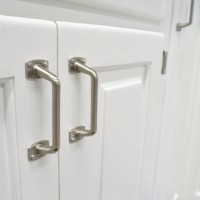
Oh and our new hardware is from here for $3.24 per handle. We love the way the satin nickel looks with our stainless appliances (and we think the soft gray backsplash will only add to the fun. We got all the same hardware for every door and drawer, but just placed them horizontally on drawers and vertically on doors. Speaking of money, here’s our entire budget breakdown:

Not bad when you compare that to the 7K total of the new white cabs that we selected for our first house’s much smaller kitchen. Le yikes. And we love that we added an entire peninsula with secondhand cabinets for under $95 (one of them was even free) – which is definitely one of those DIY coups that makes ya proud. All that storage and extra workspace is already coming in handy.

Anyway, to get back the whole putting-the-room-back-together thing, after we added the hardware, we just needed to reattach the hinges…

… and enjoy the view (don’t mind the clashy dishwasher- we’ll install our stainless one after we lay the cork floors so they’ll run underneath it).

I’ve totally been doing that thing where you spend way more time in a room than necessary, just staring at things. I keep gravitating towards the kitchen (ex: Clara, let’s go read this book on the floor next to the refrigerator!).

Oh and here’s a shot of how things look with the natural oak color inside the cabinets while the doors and fronts are painted. We don’t mind the two tone look at all, and this way we can toss things in there and pull them out without worrying about scratching or peeling paint (we did the same thing in our first kitchen and in our office built-in cabinets, and they really hold up nicely). Our tip would be to just keep a nice clean line around the frames when you prime/paint them (using a small foam roller sort of does that for you). That way it looks intentionally two-toned and not crazy-sloppy when you open the door. And yes, that is a slide out cutting board. Our cabinets may be old, but they still have their tricks. Haha.

For those who can’t watch the video above to see my shot of the painted cabinets up close, the picture below might shed a little light on the whole oak-grain thing. Using high quality primer and good self-leveling paint helps hide a lot although it doesn’t guarantee 100% invisible grain (we don’t see any evidence of grain on the oak cabinets in the office but do see a hint of it on the kitchen cabinets, so it probably just depends how much grain your cabinets have to begin with). We don’t mind painted wood that looks like painted wood though, so a little grain is ok with us, as long as the paint is nice and even and glossy.

Words can’t express how much additional function/workspace our little peninsula added to the kitchen. It’s amazing to think that none of these cabinets were here before our makeover! And the fact that we gained a 3 x 5′ counter on that peninsula already makes eating/baking/spreading out and doing crafts there a regular occurrence.

We mentioned in this post that two of the retrofitted cabinets were 100% seamless, and it’s these babies in the corner. We don’t think Sherlock Holmes himself could tell, even with his nose an inch away from them. Hurrah!

As I mentioned here, the three other retrofitted doors are tad less than perfect. By this I mean if you look at them from an inch away for five minutes (bobbing your head back and forth to catch the light bouncing off of them) two out of ten people might notice a tiny seam. The cabinet hanging above the cereal jars in the photo below is one of them. See how it’s almost impossible to pick up from far away…

But when you get super close and the light hits it just the right way you might be able to catch a super subtle horizontal line? In person it’s so unnoticeable that we can’t decide if it’s worth doing anything about, but we’ll keep you posted if we decide to sand them one more time and use some sort of buildable primer and a few more coats of paint to hopefully make them as perfect as the two corner cabinet doors are.

I don’t know why I love this shot but I do. John’s totally my hero for figuring out how to build in the fridge like that. Mah man.


Oh my gosh, can you even believe that room looked like this last December when we moved in? In case you can’t tell, it’s hard for me to wrap my brain around that.

The doorway to the dining room definitely helps bring the light in – and the glossier cabinets and bright white counters definitely brighten things up too.

Here’s the other side of Dark City:

And the same view now that I’m the Mayor of BrightVille!

Of course there’s still tons to do, like…

…but it’s definitely progress. Hooray, progress. So who’s about to embark on a cabinet painting adventure of their very own? I hope this post full of details (and especially that little video we whipped up) come in handy! Have fun and don’t forget to make up words (might I recommend putty brush?).

PS: We’re over on BabyCenter sharing a tearful little announcement. More on that here.

  Leave a comment

Clara’s Christmas Kitchen!

We did it. Holy cats, we did it.

Just a few days before Christmas we started Clara’s homemade play-kitchen (in secret of course, since she thinks Santa brought it)… and we actually finished it on Christmas Eve! Yes folks, it was a Christmas miracle. We went into it with a goal of spending under $99 since this basic play-kitchen from Ikea is that price – but we wanted to add a bit more detail like oven knobs that actually turn, an oven light that goes on and off, a wire baking rack inside the oven instead of a shelf, and a real faucet (not plumbed of course, but movable!).

So here’s how we made our own little Clara version in the last 72 hours before Christmas, for what ended up being $74…

More pics in a moment (lots more!), but first the dirty details. The core of our homemade kitchen was initially going to be a real kitchen cabinet, so we had it around already (yessss!). It was actually the one we bought for $14 from the Habitat For Humanity ReStore when we intended to hang a big microwave next to our pantry. Heck, we even hung it temporarily when determining where we wanted the electrician to add our microwave plug a while back.

But in the end it never got used (since we opted for a smaller microwave – more on that here) so we hung onto it in preparation for its eventual rebirth as a play kitchen.

It was a little low (only 15″) so we began by building it up on the bottom with a quick box made out of a 1 x 4″ remnant that we had in the basement. We offset it from the front a bit so it would even look like a real base cabinet in a kitchen (toekick and all).

John also had a spare 1 x 12″ board in his scrap wood pile that, when paired with a leftover plank from our desk-building project, fit perfectly as a counter and low backsplash. Well, perfectly once they were cut down a bit.

Picture me rubbing my hands together maniacally and saying things like “it’s all going according to plan!”

But before attaching all that, we had to build our sink area. We hit up the ReStore again and snagged a real faucet and handle for $10 (and inadvertently crashed their company Christmas party in the process – sorry ReStorians, thanks for letting us quickly grab that faucet!). We thought those two real kitchen features paired with a metal bowl (found at Target for $7) would make for a purty chrome and stainless steel kitchen sink area. Only the best for our girl. Haha.

After tracing around the lip of the bowl, John jigsawed a hole just inside the line (so the edge of the bowl had something to rest on). It didn’t have to be perfect since the bowl would be covering it.

After cutting matching holes in both the counter and the cabinet top (and sanding them both smooth), the bowl was officially transformed into a sink – just by dropping it in.

I wish I had peeled that sticker off for this pic, but you get the idea.

Adapting the sink hardware was also pretty straightforward. The faucet was pretty much ready to go, but the handle had lots of tubing that was just going to be in the way under the counter.

Luckily, with a wrench and a copper pipe cutter we removed the excess mumbo jumbo. Oh, and since the bottom of the fixture will be concealed between the top of the cabinet and the counter we don’t have to worry about Clara messing with it.

Then it just took drilling some holes…

…and securing both fixtures to the underside of the counter (though the handle was so thick it required an extra block of wood to keep it secured).

Now that we could finally secure the counter to the cabinet, it was starting to look like a play kitchen! So yes, this is where we got all weird / annoying / giddy / hyper.

But just wait, there’s more excitement in store. Check this out…

Every play kitchen needs an oven right? So we bought some $3 fence hinges to convert one door to open downwards.

And we also snagged a piece of pre-cut plexi from Home Depot (for just $3!) so that we could give Clara’s oven a proper window (the girl’s gotta check on her souffles). We completely lucked out that this pre-cut pane was the perfect size.

We weren’t so lucky when cutting the hole for the plexi though. John can’t figure out if it’s him or his Dremel Trio, but he has trouble getting straight cuts sometimes (his words, not mine). It looked okay from a distance…

…but up close he was less than happy with it. Yes, there may have even been some hushed cursing.

So after a dash to the craft store (we had to buy materials for some oven knobs anyway) we grabbed some thin pieces of craft wood and cut a miniature frame to trim out the imperfect opening. Huzzah for Plan B!

We didn’t want to actually attach the plexi until we were done priming and painting, so it was onto making some knobs for the oven. I guess knobs are usually for a stove, but we figured it wouldn’t hurt to have something for Clara to spin and interact with. So we took some small wood discs from Ben Franklin (for $2) and drilled a hole in the center for a washer and bolt.

Luck was back in our favor when it came to drilling holes for the nut on the back of the oven door. The Kreg Jig drillbit (which has a small pilot drill on the tip before becoming larger) made the perfect sized holes for not only sinking the nut into the door (since our oven wouldn’t close if they weren’t flush) but also kept the nuts from spinning too, which made attaching everything really easy.

Final attachment of the knobs wouldn’t happen ’til after painting, but here’s a preview (check out the assembled one on the left). John used some of the leftover craft wood (that he had from the Plan B oven window frame) to cut some little arrows that would later get glued over the bolt head on each knob. But back to these in a minute.

Now that everything was constructed, we snuck it upstairs to the sunroom after Clara was asleep and primed the whole darn thing (after patching some holes with wood putty). It was actually not that bad since we were in priming and painting mode for our real kitchen too. Then it was painting time, and we did all those finishing touches like gluing in the oven plexiglass and adding hardware over the next 48 hours.

The rest of the finishing touches are easier to explain while looking at the “after” kitchen, so through the magic of the Internet we’ll fast forward a bit:

We primed and painted it using leftover paint that we already had. The top is our kitchen wall color (Sesame by Benjamin Moore) and the base is the same stuff we used for our office cabinets (Benjamin Moore’s Advance paint in Decorator’s White in a satin finish). We painted the inside of the pantry Sesame also, but did the oven in a medium grey thanks to a test pot of paint that we had leftover from grey-washing our living room beams (in Benjamin Moore’s Shaker Gray). It’s sort of hard to see in the pics, but in person the gray oven and the grellow cabinet are fun little details to help each side feel more defined.

To dress up the inside of the oven we used heavy duty velcro to hold up a simple tap light, so Clara can actually “turn the oven on” just by pushing it. We also found this black wire shelf (it’s actually one of those bottom-of-the-sink drying trays) at Target for $5. It definitely helps things feel more oven-ish in there.

Oh, and here’s what the plexi-glass looks like from the back. We just used some clear silicone caulk to adhere it to the backside. That keeps it in place, but is totally invisible from the front thanks to the blessing-in-disguise frame that John had to add. Three cheers for happy accidents along the way.

We also whipped up a last-minute shelf on the sink side when we realized that most of the play food Clara was getting from her grandparents (they sweetly offered to give play-kitchen-themed Christmas gifts, knowing what we had up our sleeves) would be dwarfed by one big open cabinet. She’s got the basics covered… soup, cereal, crackers, pasta, tuna, sugar, milk (oh wait, maybe this girl needs a fridge someday…).

We opted not to add a stovetop so that she’d have more flexible-to-use-for-other-stuff-too counter space (you know, for mixing and setting out dishes, etc). It has already been a handy choice because there’s room to house the play toaster her Grammy and Tom-Tom bought her for Christmas (yes, it’s kind of the cutest thing we’ve ever seen). But I did make her a makeshift hot plate of sorts, so she has one burner to play with (instead of four space-hogging circles). What does she use it for? To fry sandwiches, apparently.

All that little DIY hot plate entailed was buying a $5 trivet from Bed Bath & Beyond and a $4 round of wood from Michael’s (which I painted teal with leftover paint from this project) and then drilled into it  in three spots (to allow the feet of the trivet to “sink” inside the wood round so it was nice and solid). Then I used a flat washer and a screw to hold the trivet into the round of wood from the center. Voila: instant burner.

Oh and I used little felt furniture feet on the bottom of my burner (to lift it up ever so slightly to keep it from scratching the counter) which you can sort of see in the picture below.

Here’s a closer look at the final oven knobs too. I sprayed them with leftover spray paint (Rustoleum’s Titanium Silver that we bought to test on our old kitchen hardware). It’s not a perfect match to the new shiny chrome door hardware ($5 each from Home Depot) and our sleek sink and faucet, but it’s close enough. And it sort of glitters, which is semi-adorable (new rule: every play kitchen should have at least one glittering element).

We actually bought three of those Home Depot door handles so that one could act as a towel bar on the side of the sink. Little details like that were kind of my favorite part. As for hatching this whole kitchen plan, John and I took Clara and Burger for a nice long walk and chatted about things we could add to “our kitchen” (didn’t want to spoil the play-kitchen surprise for Clara) which is how we came up with things like the towel bar, the wire rack, the oven tap light, all the other little details like those spinning knobs that we thought would make it Clara’s favorite thing ever. The brainstorming part of a project is always my favorite. So much possibility…

So now I think you’ve see just about every nook and cranny of this puppy (can you tell we’re proud of it?)…


So how about a budget breakdown?

And as they say in the commercials, watching Clara play with what Santa brought her: priceless.

If only a certain larger kitchen were this easy to knock out. Oh well, I guess that’s the difference between one cabinet and 20 of them. But I gotta say that this little guy is getting a ton of action. Stuffed animals regularly get bathed in the sink, fake slices of lettuce and tomato get toasted, boxes of cereal and crackers get baked in the oven, and random cars, balls, and trains get stuffed into the pantry cabinet. It’s also really nice to have a little “Clara zone” shaping up along the living room wall right off of the kitchen (we moved it to the wall on the left side of her new desk after Christmas). Good stuff.

Oh and oddly enough, folks ask us all the time what we want to “parlay” this blog-thing into, and for the past few years we’ve never really known how to answer that question because we love blogging as-is (we don’t want a TV show or anything – ack, that makes us break out in hives – so, we’ve actually turned those opportunities down a few times). But I can honestly say that “designing” Clara’s desk and her play kitchen have been hugely amazing and fun projects for both of us. So for once I might have an answer the next time someone asks what sort of side projects we’d love to end up doing in a decade or two (right along with the blog of course, since YHL = our first baby). Designing cute and affordable kid furniture (which seems to be surprisingly hard to find for some reason) might just be the sweet spot. Ya never know, right? So I’m just putting that out there into the universe. Who knows where we’ll end up…

  Leave a comment

Now, We Wait…

Ok, so we completed the door-painting process a few days ago (picture us doing the droopiest super-tired happy dance that you’ve ever seen) and we’re now into the “waiting game” portion of the cabinet painting process. But we couldn’t wait to share all the photos of everything both during the painting-process and now that they’re all glossy and finished, so here ya go:

We used Benjamin Moore’s Advance paint in Cloud Cover in a satin finish (it’s a soft tonal taupey-gray color, so it’s not quite as bright as our glacier white counters for a subtle layered look). Benjamin Moore Advance paint (in the satin finish) actually came recommended by a few pro cabinet painters that we know. We used it on our office cabinets a few months back (which still look mint after Clara has beat on them relentlessly with wooden toys) so it’s safe to say that we’ve been extremely happy with it. The fact that it’s low-VOC, self-leveling, and amazingly durable is pretty much the cabinet paint trifecta.

Just like we did for the office cabinets, we applied it with a high quality 2″ angled brush to get into all the cracks and a small foam roller to smooth everything out and ensure that we were applying super thin and even coats. As for applying any sealer or topcoat, the general pro recommendation for cabinet painting is to use high quality stain blocking primer and 2-3 thin and even coats of super high quality paint with ample drying time between coats (Benjamin Moore’s Advance paint is meant for cabinets without any top coat, since sealers can drip, yellow, and even cause things to stick/crack since they thicken the application). We’ll be back with a video on Wednesday to share more actual application details/tips along with the big full monty reveal (we thought it would be helpful to share one exhaustive how-to-paint-cabinets-post with a detailed tutorial, application video, and the after pics all in one spot).

Using high quality primer and good self-leveling paint helps hide a lot although it doesn’t guarantee 100% invisible grain (we don’t see any evidence of grain on the oak cabinets in the office but do see a hint of it on the kitchen cabinets, so it probably just depends how much grain your cabinets have to begin with). We don’t mind painted wood that looks like painted wood though, so a little grain is ok with us, as long as the paint is nice and even and glossy.

For those wondering how those few retrofitted doors that we whipped up are doing with primer and paint (more on that process here), some of them are completely seamless (the two corner cabinet doors might even stump a detective) while a few others are a tad less than perfect. By this I mean if you look at them from an inch away for five minutes (bobbing your head back and forth to catch the light bouncing off of them) two out of ten people might notice a tiny seam. See the über light horizontal seam on the door with the arrow in this pic below?

Yeah, me either. Haha. It’s nearly invisible and impossible to photograph. But once we hang them all we’ll take some close up pics for ya. Even in person it’s so subtle that we can’t decide if it’s worth doing anything about (thankfully at least two of the five doors are seamless, so we’re leaving those for sure). We’ll keep you posted if we decide to sand the other three one more time and use some sort of buildable primer and a few more coats of paint to hopefully make them as perfect as the two corner cabinet ones).

We’re psyched to have two perfect ones among the group because it gives us faith that if we want to be super type-A about things, we can probably get all of them to look that good with a little more work (if none of them worked out we’d bag it and go with Plan B). All in all I’d say we’re really happy about being able to work with our existing cabinets to save some major loot (thereby making other upgrades like new appliances, cork floors, new counters, new backsplash tile, and a big opening into the dining room possible).

So for $40 in paint (ya know we used a $10 off coupon, haha) and $22 in primer, we’re beyond overjoyed at the new layout and the lighter look! Painting cabinets is right up there with painting wood paneling or dark brick – we think it’s one of the biggest bangs for your buck. It’s amazing what 60 bucks can get ya. Well, 60 bucks and a week of puttying, sanding, deglossing, priming, painting, and waiting not-so-patiently to put everything back together.

Oh and we primed and painted the outside of the frames and the front and back of the doors while leaving the inside of the cabinets oak. This way we can toss things in there and pull them out without worrying about scratching or peeling paint. We also like the two-toned effect of clean paint with wood interiors (we did that in our old kitchen and in our office built-in cabinets and really love the surprise of natural wood when you open the door).

Of course the room’s still pretty white-washed since the rich cork floors aren’t in yet, but we’ll get there eventually. And now for a bunch more random doorless pics. This is fun because you can spy on all of our kitchen items like my pretty blue cassarole dish:

This shot makes me long for our backsplash tile to go up (after we hang our cabinet doors and add hardware it’s next on the agenda!).

Yes, our tree is still up. I always hate taking down my glowy happy friend.

It’s so light and airy in here now… except for that terrible bisque dishwasher. Egads. Can’t wait to install the new one (after we lay the new flooring so it can run under it).

These two views (the one above and below) are a lesser seen angle (taken from the office doorway). I still do that “ahh!” thing when I walk in that way because I keep picturing the dark old kitchen that used to be there.

You know, the one that looked like this (although John didn’t always stand on the counter like that).

I like it a lot better now.

And once we add the 12″ deep floating shelves and a range hood over the stove, things like the sink window will look a lot more balanced (there will be 14″ of space on either side of it):

We’ll be back with an entire cabinet-painting tutorial complete with a detailed video and lots after photos on Wednesday when things are finally cured enough to hang the doors and add hardware. Ahhhhhhhhhhhhh, even typing that is more thrilling than I should admit. I’m off to watch paint dry. Literally. Ok, and write more book stuff. There’s nothing like an entire-manuscript deadline of the 4th to get the year off to a ca-razy start! But just like fiiiinally finishing our painted cabinets, handing in our huge 260+ page beast of a book should feel pretty darn good! Then we just have to shoot 100 secret photos/projects in our house over the next two months. Ah chaos, come on in and get comfortable. I hope you don’t mind an in-progress kitchen…

Psst- In case you were off caroling and cavorting, here’s a roundup of all the posts that you may have missed over the “holiday break”:

Glad to have ya back!

  Leave a comment

Priming In Progress!

Between finalizing our 260+ page book manuscript (due Jan 4th- ack!) and hosting/enjoying family time (and lots of delicious food), we’ve also been priming! Can I get a “holla!”? Or more likely, a “you’re crazy.”

Thank goodness our guests are so understanding! Oh man, and it feels great to be seeing some progress.

The beauty of primer is that it always looks a little rough (so you don’t have to stress about getting it to look perfect). By nature, it’s just a sticky sub-layer that helps grab paint and hold on for the long haul, so as long as you apply things thinly and evenly (drips = baaaaad), you’re all set to just follow the recommended drying time and then get right to painting!

You definitely want to use a stain-blocking primer when painting wood cabinets (especially when they’ve been stained and exposed to kitchen grease like ours). We chose Zinsser’s Smart Prime (a super high quality low-VOC primer sold at our local Benjamin Moore store that was recommended by two different pro cabinet painters). The nice thing about it is that it’s “open” a bit longer than some other primers, so it doesn’t dry right away while you’re still trying to work it into the cracks and smooth it out to make sure it’s not drippy or bumpy. And it’s nice and durable, so it should definitely help with those decades-of-great-results that we’d like.

Oh and we use a small foam roller and a 2″ angled brush for the smoothest application. Of course there are a million other primer steps to share (and even a video to show exactly how we apply it), so we’ll be back to detail every last step (arms. too. tired. to. type.) next week.

You know, after the painting’s done and our sweet and extremely understanding house guests bid us adieu. Until then, picture us painting / doing the happy dance / book editing / asking everyone if they’d like something to eat or drink (in the dining room or living room since the kitchen’s kinda out of commission).

Oh man, this is totally the exciting part though. And we’re inexplicably excited to add hardware once everything cures up. Yes, we’re strange birds. New hardware = beyond thrilling. Especially when the room used to look like this:

Wahooo progress!

Psst- Check out this kitchen post all about how we prepped our cabinets for paint and this one about how we picked hinges and a cabinet color.

Psssssst- We picked this week’s giveaway winner. Click here to see if it’s you!

  Leave a comment